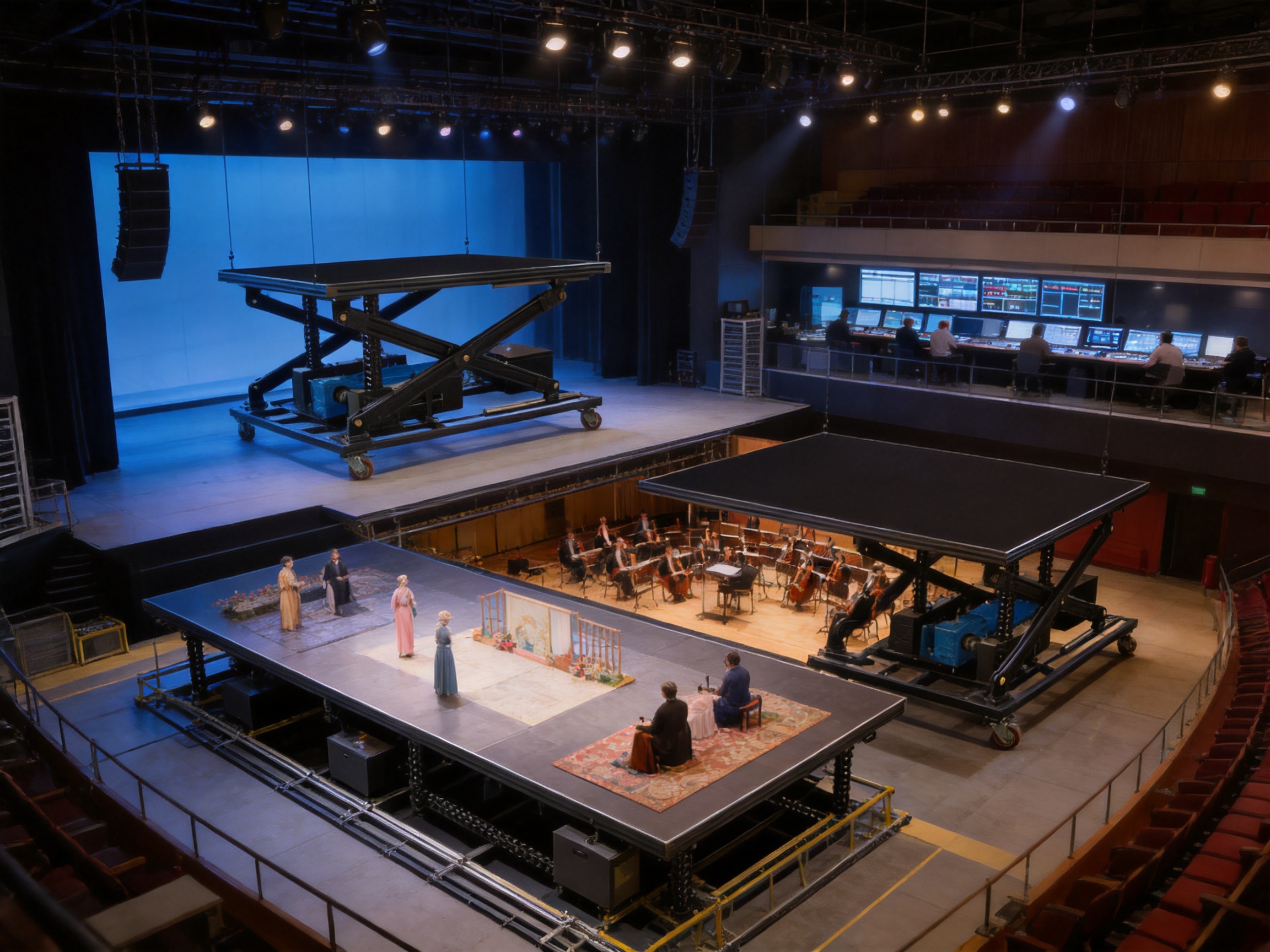
Modern performance venues require stage machinery that can move scenery, platforms, performers, and technical equipment with accuracy, repeatability, and dependable safety. A stage lift is no longer judged only by whether it can raise a platform. It must also integrate with digital control systems, operate quietly during performances, maintain a stable surface under changing loads, and support the demanding schedules of theaters, cultural centers, conference venues, stadiums, and multifunctional performance spaces.
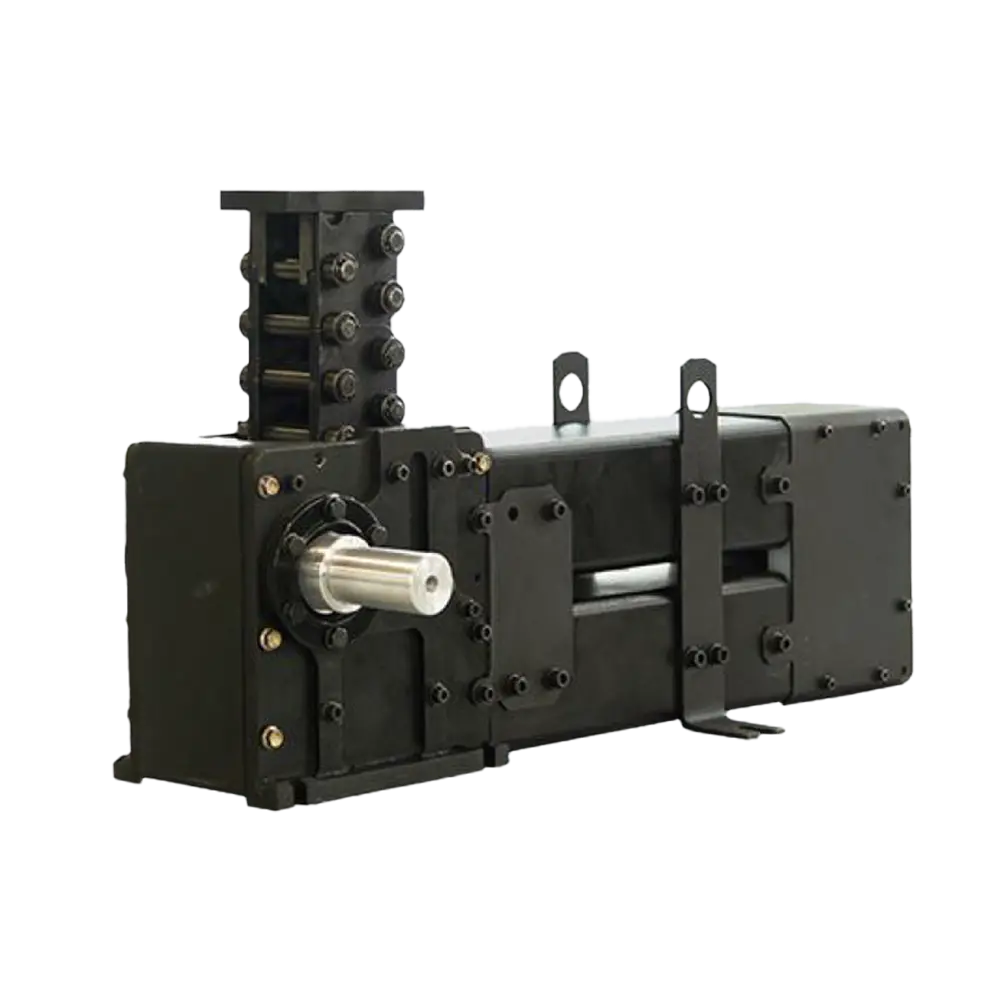
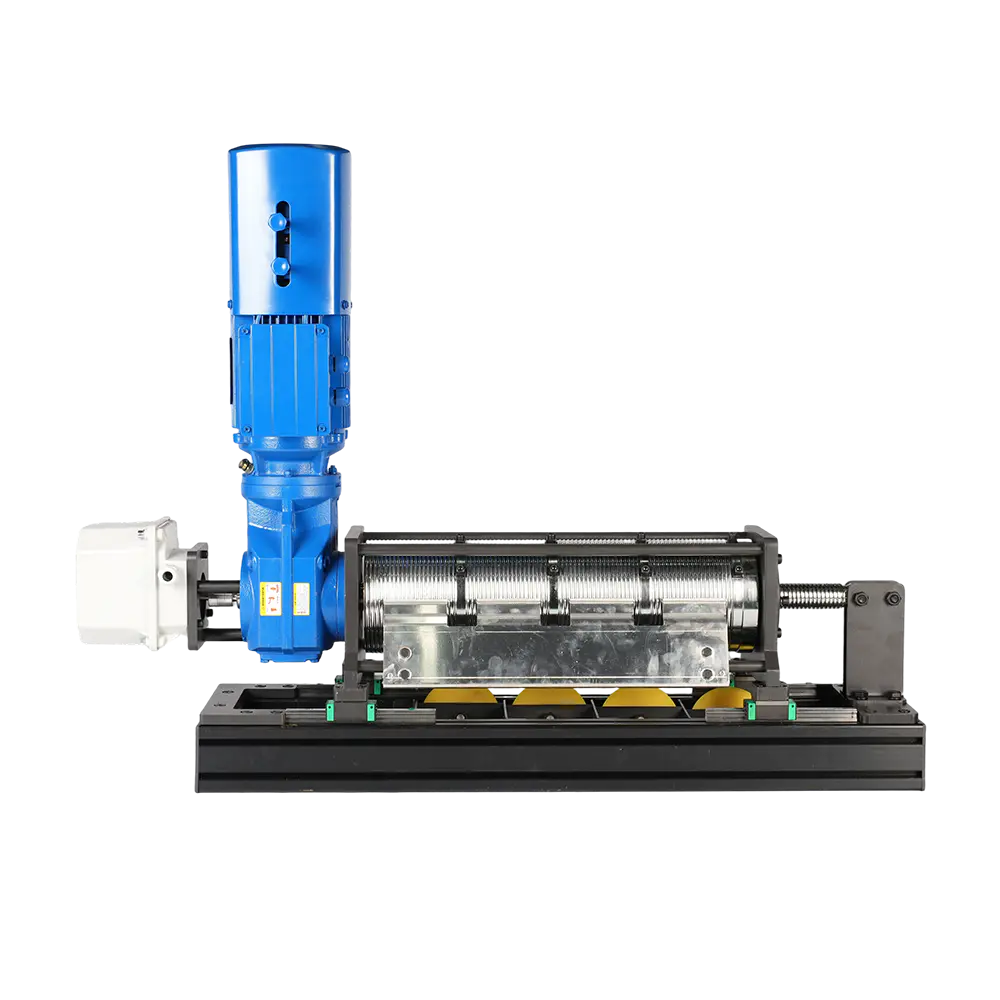
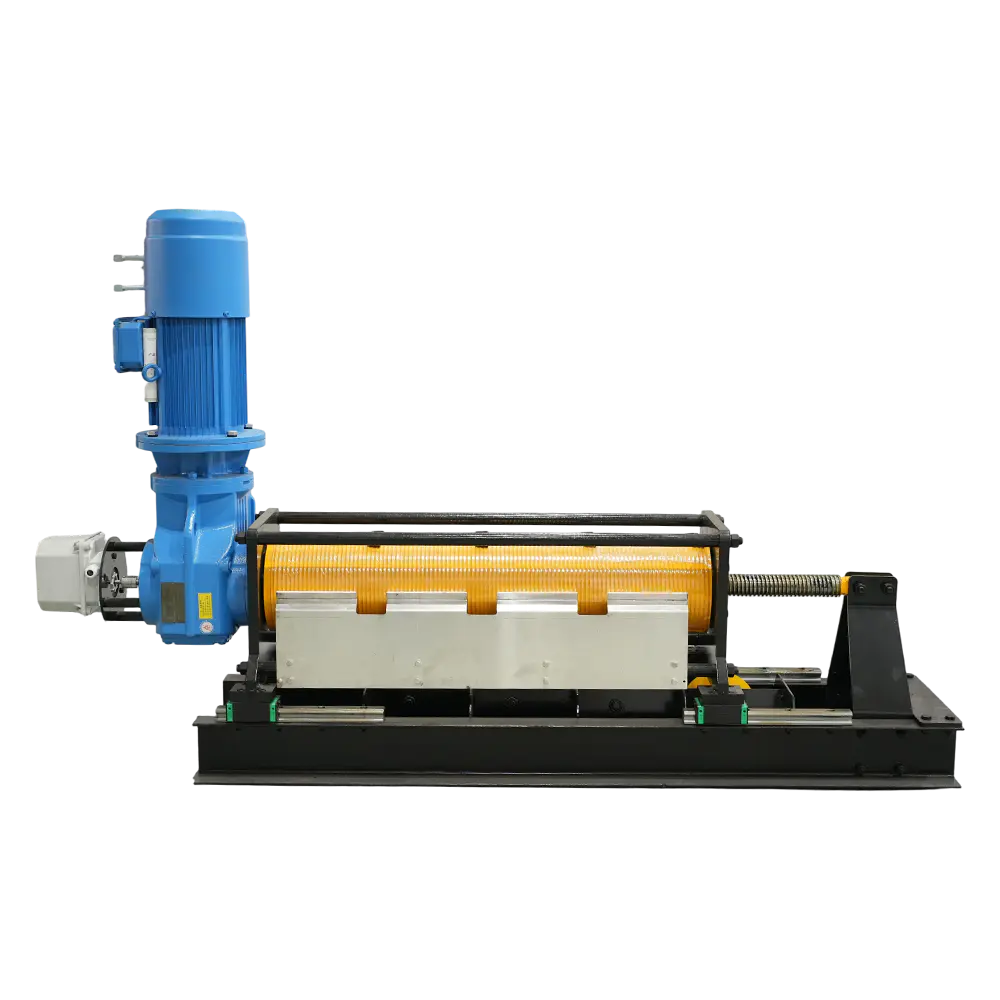
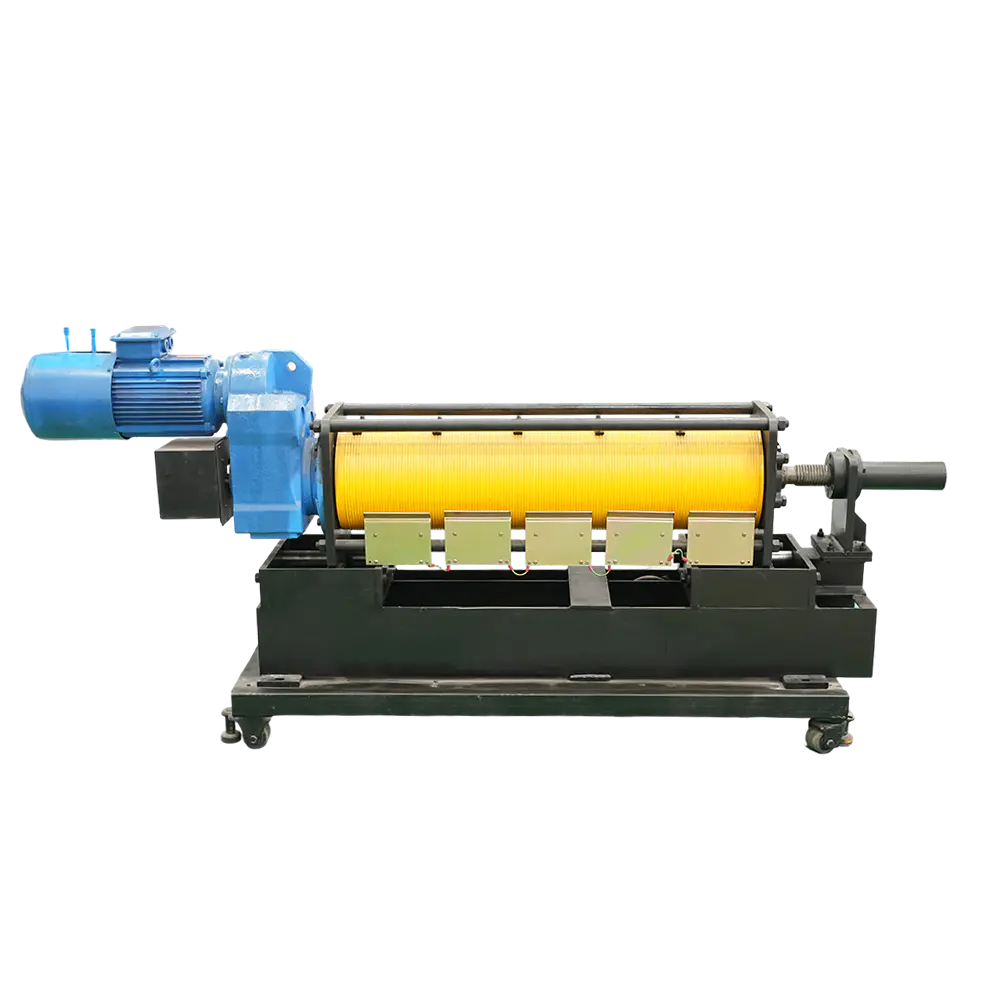
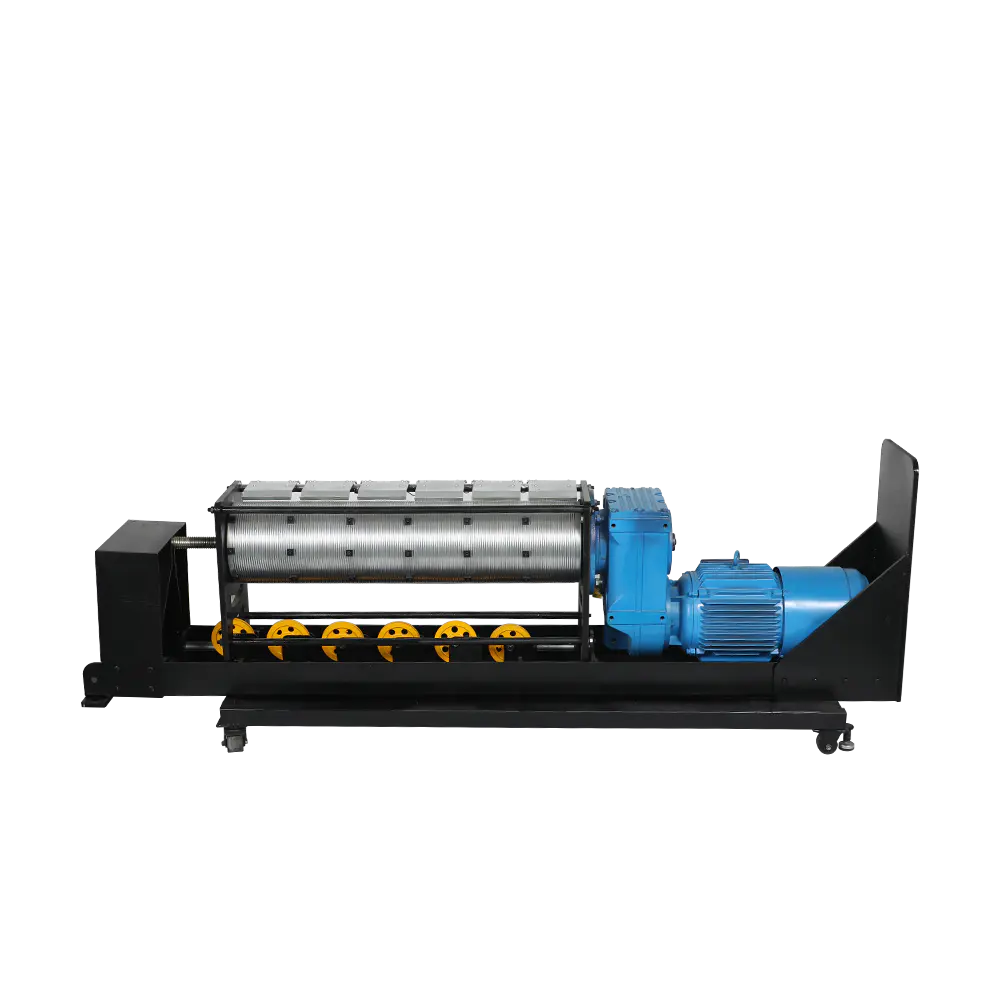
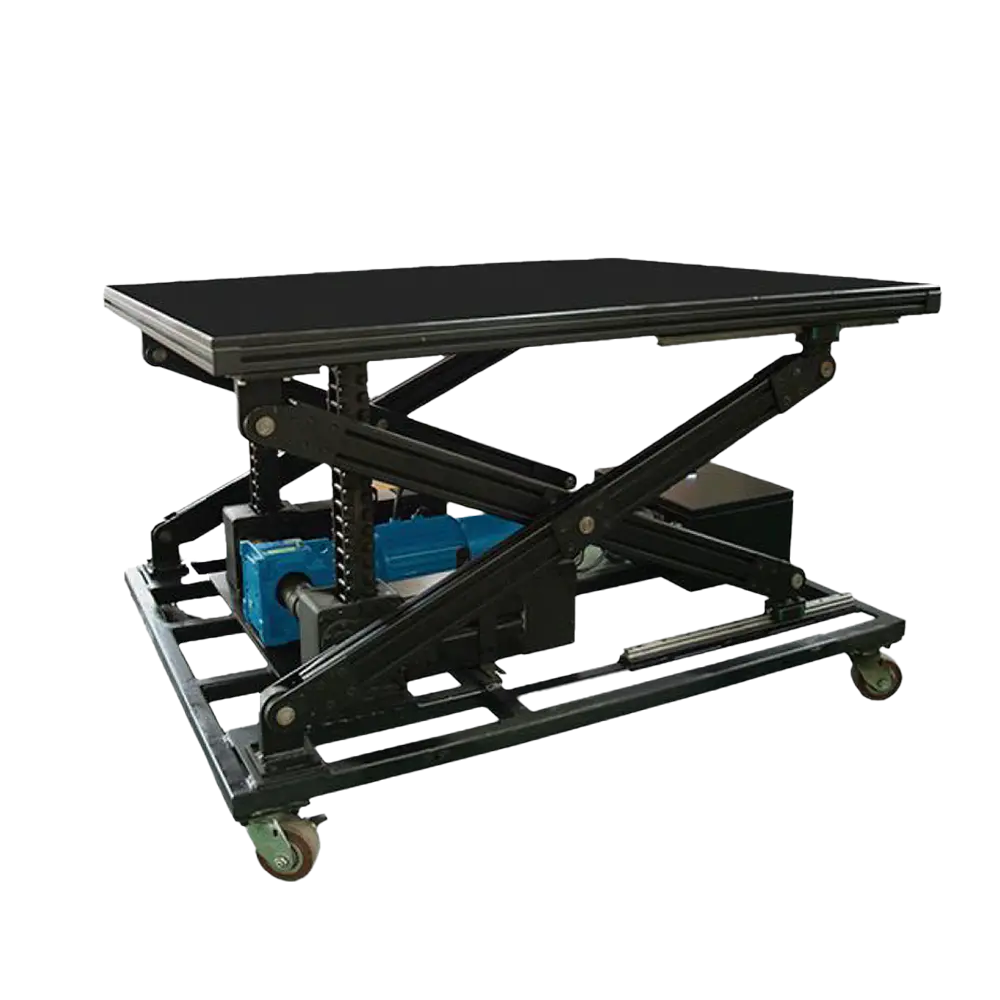
The Rigid/Screw/Rack/Chain Lifting Chain Lift Table is designed for this exact environment. It combines an electric motor, reducer, rigid chain lifting mechanism, guiding racks, linear guidance, stage-platform construction, and X-tracing supports into one coordinated lifting solution. With a standard lifting velocity of up to 150 mm/s, it provides smooth vertical movement while allowing the configuration to be adapted to different platform sizes and payload requirements.
Its central mechanical feature is the rigid chain system. Unlike a conventional cable that primarily lifts through tension, a rigid chain can push as well as pull. When extended, the interlocking links form a self-supporting column capable of transferring vertical force from below the platform. This creates new possibilities for stage-level lifting because the platform does not necessarily depend on an overhead suspension structure.
The system is also designed around modularity. Single-chain, double-chain, and multiple-chain configurations can be selected according to the required load and platform arrangement. When combined with linear guides and X-tracing supports, synchronized chains provide a stable and accurately guided platform that resists lateral movement, twisting, and uneven loading.
Manufactured and engineered by RenteZhihe (JiangSu) Equipment Technology Co., Ltd., the lift table reflects a broader capability in stage machinery, performance equipment, and intelligent control systems. The company supports projects through design, production, installation, commissioning, operation, and maintenance, allowing customers to obtain an integrated solution rather than an isolated mechanical component.
A stage lift operates in a demanding environment. The platform may need to meet the surrounding stage with minimal height difference, carry scenery or technical equipment, and repeat the same movement thousands of times over its service life. It may also be required to remain stable while performers walk across it or while loads are positioned away from its center.
These operating conditions create several engineering challenges. The lift must generate sufficient force without sudden movement. It must maintain its trajectory as the platform rises and descends. It must control deflection under load. It must avoid excessive vibration and noise. It must coordinate with other stage systems and respond consistently to digital commands.
A platform that rises quickly but tilts under an off-center load is not suitable for professional use. Similarly, a mechanism that reaches its nominal speed only under ideal conditions may cause timing problems when integrated with lighting, sound, projection, or automated scenery. For this reason, a reliable stage lift should be evaluated as a complete motion system rather than by considering motor power or lifting speed alone.
The Rigid Chain Lift Table addresses these requirements through the coordinated operation of its lifting, guiding, supporting, and control-related components. The chain delivers the lifting force. The reducer manages torque and output speed. Linear guides control the platform path. X-tracing supports contribute structural stability. The platform and its frame distribute the working load. Digital and inverter-based control options help regulate the movement profile.
This integrated approach provides a practical foundation for stage-level changes. A lift can be used to raise a performance platform into the stage plane, lower scenery below the stage, reveal a secondary acting area, or position equipment within a multifunctional venue. The same design principles can be adapted to different dimensions and load conditions.
The defining feature of this lift table is its rigid chain. A conventional wire rope is flexible and normally works by transmitting a pulling force from an elevated drum, sheave, or support point. That arrangement can be effective, but it often requires overhead space and careful management of rope tension, winding, and deflection.
A rigid chain operates differently. Its links are designed to interlock as the chain extends, creating a column that can transmit force in compression as well as tension. In a vertical lift table, this means the chain can push the platform upward from below. When retracted, the chain is compactly stored in a dedicated chain box.
This push-pull capability provides several advantages for stage automation:
The chain should not be viewed as the only structural element responsible for platform stability. A professional lift table depends on the relationship between the rigid chain, the guides, the bracing, the frame, and the control system. The chain supplies controlled vertical force, while the guide and support elements manage the forces that occur when the platform is loaded unevenly or subjected to horizontal influences.
For performers, this distinction is important. A platform must feel solid underfoot rather than flexible or uncertain. For technical operators, it means the lift can be positioned repeatedly with a high degree of consistency. For venue designers, it can simplify the planning of stage-level mechanisms where overhead access is limited or undesirable.
Cable-based lifting systems remain useful in many applications, but they are not automatically the best solution for every stage platform. Cable systems generally depend on tension. Their design may require overhead support points, drums, sheaves, counterweights, or additional routing equipment. The suitability of that arrangement depends on the building structure, available space, payload, travel distance, and required motion behavior.
The rigid chain lift table offers an alternative for projects where push-pull lifting, compact storage, and platform stability are priorities. Because the chain forms a self-supporting column during extension, the lift can be arranged without depending on a cable suspended from a high overhead point. This can help preserve ceiling clearance and simplify the integration of the mechanism below or alongside the platform.
A rigid chain also avoids some of the elastic behavior associated with long flexible lifting members. Under a changing load, a cable can exhibit slight stretch or movement. The actual performance of any cable system depends on its design, but a rigid chain arrangement can provide a more direct force path and a firm mechanical feel under load.
| Consideration | Rigid Chain Lift Table | Conventional Cable-Based Lift |
|---|---|---|
| Primary force behavior | Push-pull force through a rigid chain column | Primarily tension through a flexible cable |
| Overhead dependency | Can operate without a conventional overhead lifting point | May require overhead routing, support, or suspension equipment |
| Load configuration | Single, double, or multiple synchronized chains | Often dependent on drum, sheave, and cable arrangement |
| Storage when retracted | Compact storage in a chain box | Storage on a drum or through a cable-routing system |
| Platform stability | Supported by chain, guides, and X-tracing structure | Depends on cable arrangement and separate guidance structure |
| Control integration | Suitable for digital and inverter control systems | Also possible, but system behavior depends on the complete cable mechanism |
The comparison does not mean that a rigid chain is universally superior in every lifting application. Selection should be based on platform dimensions, payload, travel, speed, installation conditions, duty cycle, and safety requirements. However, for stage-level platforms requiring compact integration, accurate positioning, and stable load handling, rigid chain technology offers a particularly strong combination of mechanical and operational advantages.
One of the most practical characteristics of the lift table is its modular chain configuration. Stage platforms vary significantly. A small presentation platform may require only one lifting chain, while a larger scenic platform may need two or more chains arranged to distribute the load across its frame.
A single-chain configuration can be suitable for compact platforms and moderate loads when the structural design and center of gravity allow it. It provides a relatively simple mechanical arrangement and can be efficient where the platform footprint is limited.
A double-chain arrangement can distribute lifting forces across two locations. This may improve balance and reduce the concentration of force at one point. It is useful where the platform is wider, where the load may move across the surface, or where the project requires greater structural support.
Multiple-chain configurations can be selected for larger platforms, heavier scenery, or specialized stage structures. Increasing the number of chains is not simply a matter of adding more lifting points. The chains must be synchronized so that they extend and retract at matched rates. Without synchronization, one chain may advance faster than another, causing the platform to tilt, bind, or experience uneven loading.
The engineering value of modularity lies in the ability to adapt the mechanism to the project instead of forcing every application into one fixed configuration. Chain count, guide arrangement, platform structure, and control parameters can be considered together during the design process.
For customers, this means the lifting system can be selected according to actual project requirements. A venue does not need to choose between an undersized standard lift and a completely different mechanism for a larger platform. The basic rigid-chain principle can remain consistent while the number and arrangement of chains are adapted.
Synchronization affects both safety and presentation quality. A stage platform that rises with one side leading the other can create an unacceptable visual effect and may place unwanted stress on the guides and frame. In a professional venue, even a small loss of level can affect scenery alignment, performer confidence, and the connection between the platform and adjacent stage surfaces.
The lift table is intended to keep multiple chains operating together. Digitalized control and inverter control can be used to regulate the motion and support accurate positioning. The mechanical system must also be assembled with careful attention to alignment, chain engagement, guide positioning, and load distribution.
Synchronization is therefore achieved through a combination of mechanical precision, coordinated drive behavior, appropriate control parameters, and commissioning. It is not the result of chain quantity alone. The complete system must be evaluated under the intended load and travel conditions.
The rigid chain provides vertical lifting force, but it is not by itself responsible for maintaining a perfectly straight platform path. This is the role of the guidance and support system. The lift table uses linear guides and X-tracing supports to help control movement and resist unwanted structural behavior.
Linear guides constrain the platform so that it travels along a defined vertical path. They reduce lateral drift and help keep the platform aligned with the surrounding stage. This is particularly important when the platform must stop at a precise level or when several moving elements must meet at a common elevation.
X-tracing supports provide a diagonal support pattern that contributes to rigidity. When a performer, piece of scenery, or technical load is positioned away from the center of the platform, the resulting forces can create twisting or racking. The X-tracing arrangement helps resist these effects and supports a more stable platform structure.
| Component | Primary Function | Operational Benefit |
|---|---|---|
| Rigid chain | Transfers vertical push-pull lifting force | Enables compact and direct platform elevation |
| Electric motor | Provides rotational drive power | Supports controlled and repeatable movement |
| Reducer | Manages torque and output speed | Matches motor behavior to lifting requirements |
| Linear guides | Constrain the platform to a vertical path | Improves alignment and positioning accuracy |
| X-tracing supports | Resist twisting and racking | Improves stability under off-center loads |
| Chain box | Stores retracted chain links | Maintains a compact installation arrangement |
| Digital or inverter control | Regulates motion and positioning behavior | Supports integration with automated stage systems |
Each component addresses a different operating requirement. The chain creates movement, the reducer shapes the mechanical output, the guides control direction, and the bracing protects the platform geometry. This division of functions is one reason the lift table can maintain accurate movement over repeated operating cycles.
The standard lifting velocity of up to 150 mm/s provides a useful balance between responsive stage movement and controlled operation. In a performance environment, speed must be considered together with smoothness, positioning accuracy, payload, acceleration, deceleration, and the required sequence of the production.
A platform that moves rapidly but stops abruptly may create noise, vibration, and unnecessary stress. A platform that moves slowly but inconsistently may interrupt a cue or create timing differences between performances. The practical value of the rated speed comes from its ability to be delivered in a predictable and controlled manner.
Digital stage systems often coordinate platform movement with lighting, sound, video projection, scenic automation, and performer entrances. If a cue instructs the platform to reach stage level after a fixed interval, the motion must be repeatable from one cycle to the next. Constant force and speed output during operation help establish this predictability.
The reducer plays an important role in translating motor speed into suitable lifting output. The power and speed delivered by the lifting mechanism remain directly related to the reducer’s operating behavior. Control settings can then be selected according to the project requirements, allowing the system to achieve smooth starts, controlled travel, and accurate stops.
Actual performance will depend on the selected load, platform size, travel distance, chain configuration, environmental conditions, and control settings. The 150 mm/s figure should therefore be understood as a standard available lifting velocity rather than a promise that every configuration will operate at the same speed under every condition.
Stage machinery increasingly forms part of a larger automated production environment. Operators may control multiple lifts from a centralized console, execute programmed scenes, or coordinate platform movements with other automated equipment. Compatibility with digitalized control systems is therefore an important design consideration.
The lift table can work with digital control and inverter-based control arrangements. These systems can support adjustable speed, controlled acceleration and deceleration, repeatable positioning, and coordinated operation. They also provide a path toward integrating the lift with the venue’s broader stage automation architecture.
Control integration should begin during project planning. The mechanical system, motor and reducer selection, sensor arrangement, electrical cabinet, control interface, and emergency functions should be considered as one package. Early coordination helps prevent problems caused by mismatched signals, unsuitable operating ranges, or insufficient space for control equipment.
For a production team, automation compatibility offers more than convenience. It can reduce repetitive manual operation, improve cue consistency, and help operators manage complex stage transitions. For maintenance personnel, a structured control system can make it easier to observe operating conditions, identify irregular behavior, and organize preventive service.
Any automated lifting system must be commissioned carefully. Travel limits, stop positions, synchronization, load behavior, emergency functions, and communication with the main control system should be verified before the equipment is placed into regular performance use.
Safety is a central requirement for any machinery that moves a platform in an occupied performance space. The lift table is designed with several safety-oriented characteristics, including rigid load-bearing chains, guided movement, configurable chain arrangements, controlled output, and compatibility with digital control systems.
The rigid chains are designed to bear vertical and horizontal loads within the intended system configuration. Their compact storage in chain boxes helps protect the retracted chain arrangement and keeps the mechanical layout organized. The use of multiple chains can distribute forces and contribute to a more secure platform when the application requires it.
Linear guides and X-tracing supports help reduce unwanted movement. By constraining the platform path and resisting twisting, they support a more predictable mechanical response. This does not eliminate the need for correct loading, inspection, or operational procedures, but it provides an important structural foundation.
Quiet and reliable operation is also a safety-related consideration. Excessive noise can indicate vibration, misalignment, wear, or unsuitable operating conditions. A smooth system is easier for operators to monitor and less disruptive during performances, rehearsals, and events.
Safety must be addressed at the system level. Project-specific design should include suitable guards, access controls, limit arrangements, emergency stop functions, inspection procedures, maintenance schedules, and operating rules. Installation and commissioning should be performed by qualified personnel in accordance with the applicable requirements for the venue and jurisdiction.
These practices complement the mechanical design. No lifting mechanism should be treated as maintenance-free, and no control system can replace responsible operation and inspection.
Rigid/Screw/Rack/Chain Lifting Chain Lift Table
The quality of a stage lift depends on more than the visible design. Precision in manufacturing, assembly, alignment, testing, and documentation determines how well the mechanism performs after installation. A lift table may contain robust components, but if the chain path, guide rails, frame, or drive alignment is not controlled carefully, the final system may experience unnecessary wear or inconsistent movement.
RenteZhihe (JiangSu) Equipment Technology Co., Ltd. approaches stage machinery as an integrated engineering product. Its capabilities cover research and development, manufacturing, installation, commissioning, operation, and maintenance. This broad service structure allows the company to consider the complete life cycle of the equipment rather than focusing only on fabrication.
The manufacturing process begins with understanding the application. Important design inputs include platform dimensions, rated load, travel distance, lifting speed, available installation space, stage structure, operating frequency, control requirements, and the expected use of the venue. These factors influence the choice of chain configuration, motor and reducer arrangement, guide system, platform frame, and control strategy.
During the design stage, the engineering team can evaluate whether a single, double, or multiple-chain configuration is suitable. The position of each chain must correspond with the platform’s structural load path. Guides and X-tracing supports must be arranged so they can resist the anticipated lateral and twisting forces.
Design review also considers installation and maintenance access. A mechanism that performs well in a drawing but cannot be inspected conveniently after installation is not a complete solution. Chain boxes, drive components, guides, electrical interfaces, and access areas should be positioned with future service requirements in mind.
Where the lift forms part of a larger automated stage, mechanical and control considerations must be reviewed together. The selected reducer output, motor characteristics, control signals, and stopping behavior should be compatible with the intended operating sequence.
Manufacturing quality begins with the preparation of the main mechanical components. Structural members, guide supports, chain boxes, platform frames, and bracing elements must be produced according to the approved design. Dimensional control is especially important for components that affect chain alignment or guide parallelism.
Rigid chains require correct link engagement and a suitable relationship between the chain, drive mechanism, and storage box. The chain path must allow smooth extension and retraction without unnecessary interference. The chain box must accommodate the retracted links while maintaining an organized and protected arrangement.
Reducer and motor mounting surfaces must be prepared so that the drive assembly can be aligned correctly. Guide components must be positioned accurately in relation to the platform frame. X-tracing supports must be connected firmly and arranged to provide the intended resistance to racking and twisting.
Assembly is a critical stage because the lift table operates as a coordinated mechanism. The motor, reducer, chain lift, guides, platform, and bracing cannot be treated as independent parts once they are installed. Their relative alignment affects load distribution, noise, friction, speed consistency, and service life.
During assembly, technicians should verify that the chain engages properly with the lifting mechanism, that the platform is square with its guide system, and that the X-tracing elements are installed without unwanted distortion. Fasteners and connection points should be checked according to the project’s technical requirements.
Multiple-chain systems require special attention to chain spacing and synchronization. The chains must share the load as intended and maintain the platform’s level during travel. Mechanical alignment provides the foundation, while control adjustment completes the synchronization process.
Before shipment or site installation, the completed lift table can be reviewed for mechanical movement, structural integrity, chain engagement, guide behavior, and control compatibility. After installation, commissioning verifies the actual behavior of the system within the venue.
Commissioning may include no-load travel, controlled loading, full travel checks, stop-position verification, synchronization adjustment, speed evaluation, noise observation, emergency function testing, and communication checks with the venue control system. The exact test program should reflect the project requirements and applicable regulations.
This staged process helps identify issues before regular performance use. If movement is not smooth, if the platform does not maintain level, or if the system does not stop accurately, the cause can be investigated while technical personnel and adjustment resources are available.
Purchasing a stage lift from an integrated manufacturer can simplify communication and responsibility. When design, production, installation, commissioning, and maintenance are divided among unrelated suppliers, important information may be lost between stages. The final operator may be left to coordinate mechanical, electrical, and control issues independently.
RenteZhihe provides a service system that covers the full project process. This allows the company to understand the original design intent when producing the equipment and to apply that knowledge during installation and commissioning. It also creates a clearer basis for maintenance and future technical support.
The company’s specialization in stage machinery, performance equipment, and intelligent control systems is particularly relevant to automated lifting applications. Stage machinery must work within artistic, architectural, electrical, structural, and operational constraints. A manufacturer familiar with these relationships can help develop solutions that are practical for actual performance venues.
Its products are intended for theaters, cultural centers, stadiums, conference centers, and multifunctional performance spaces. These venues have different priorities. A theater may emphasize silence and precise cueing. A conference center may require flexible room conversion. A stadium may involve larger platforms and heavier equipment. A multifunctional venue may need repeated changes between event formats. The modular lift-table concept can be adapted to these different uses.
In theaters and opera houses, a lift table can support stage-level transitions, scenic reveals, orchestra or performer platforms, and the vertical movement of production elements. The ability to maintain accurate positioning helps preserve the visual relationship between moving platforms and fixed stage surfaces.
The rigid chain system can be useful where overhead rigging space is limited or where the venue prefers to keep the lifting mechanism below the stage. Smooth motion and controlled stopping are important for productions in which movement is visible to the audience.
Cultural centers often host a wide range of programs, including concerts, drama, dance, ceremonies, exhibitions, and public events. A configurable lift table can help transform the stage arrangement for different uses. Single or multiple-chain configurations can be selected according to the size and load of the platform.
Digital control compatibility allows operators to incorporate the platform into programmed event configurations. This supports repeatable setup and reduces the time required to change between different stage layouts.
Conference venues may need to convert between presentations, product launches, award ceremonies, and entertainment programs. A lift table can provide a discreet way to raise a lectern, demonstration platform, display structure, or performance area when required.
The compact chain-storage arrangement can be advantageous in spaces where the mechanism must remain concealed or where the architecture does not allow a large overhead lifting structure.
Large event spaces may require robust platforms capable of supporting equipment, scenery, or performance structures. Multiple synchronized chains can help distribute loads across a larger platform when the project design requires it.
Large venues also benefit from reliable control integration. A platform may need to be coordinated with event timing, video content, lighting, sound, and crowd-management procedures. Accurate, repeatable movement is essential when the equipment forms part of a live broadcast or high-profile event.
Multifunctional spaces must balance flexibility with equipment reliability. Their stage machinery may operate more frequently and serve different users over the course of a year. A lift table that is straightforward to configure, install, operate, and maintain can support this changing demand.
The ability to select chain count and adapt the platform structure gives designers more freedom when planning a venue that may change function from one event to another.
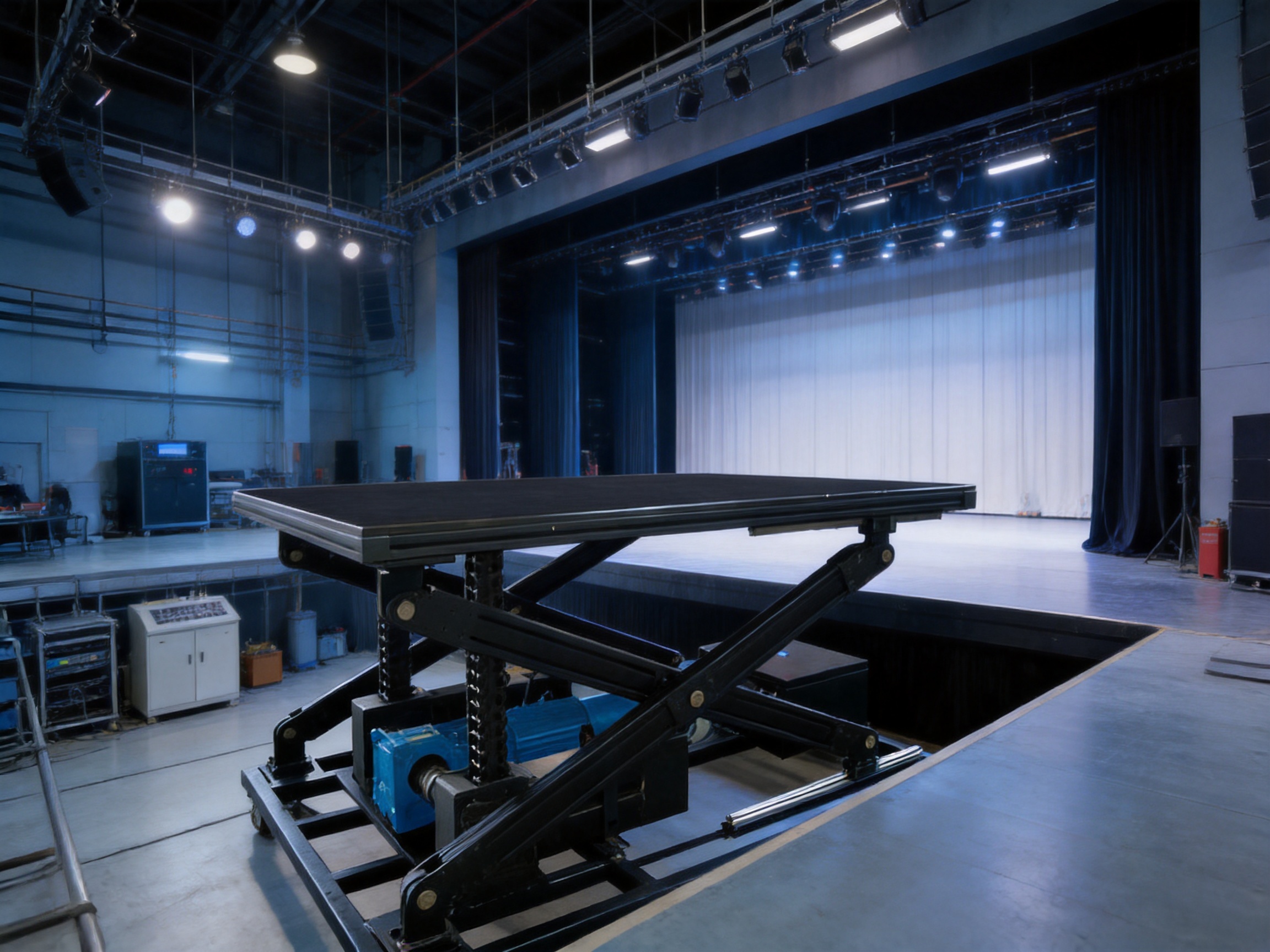
Successful installation begins before the equipment arrives at the venue. The project team should confirm the pit dimensions, structural support points, access routes, electrical supply, control-system interfaces, maintenance clearances, and final platform elevation.
The relationship between the lift table and the surrounding stage is especially important. The platform must reach the required stage level while maintaining suitable clearances throughout travel. Adjacent scenery, walls, guard systems, cable routes, and service access must be considered.
For multiple-chain systems, installation teams should verify the intended spacing and load path. The platform should be checked for level during initial movement, and any required adjustments should be completed before final commissioning.
Control integration should be coordinated with the venue’s electrical and automation contractors. Signal definitions, emergency circuits, operating modes, limit devices, and operator interfaces should be documented clearly. This avoids confusion when the lift table is connected to a larger stage control network.
RenteZhihe’s service coverage from design through commissioning can help coordinate these activities. The company can work with project stakeholders to clarify technical requirements and ensure that the mechanical equipment fits the operating environment.
A stage lift is a long-term capital asset. Its service life depends on correct selection, installation, operating discipline, inspection, and maintenance. The lift table is designed for smooth operation and long service life, but regular attention remains necessary.
Maintenance personnel should inspect the rigid chain for wear, damage, contamination, abnormal movement, and correct engagement. The chain box should be kept in suitable condition so that retraction and extension remain unobstructed. Guides should be checked for cleanliness, alignment, wear, and secure mounting.
The motor and reducer should be observed for abnormal noise, overheating, leakage, vibration, or changes in operating performance. Platform fasteners, X-tracing supports, structural connections, and safety-related devices should also be included in the inspection program.
Control-system maintenance should include review of limit behavior, emergency stop functions, communication signals, fault records, and programmed positions. If the platform begins to move unevenly or stop inaccurately, continued operation should be evaluated by qualified personnel rather than ignored.
A preventive maintenance program can identify small changes before they develop into major failures. It also provides useful records for planning replacement parts, scheduling service, and demonstrating responsible equipment management.
Before selecting a rigid chain lift table, the project team should define the application in measurable terms. Important questions include:
The answers to these questions should be used to develop a project-specific configuration. A lifting system should not be selected solely because it has a high nominal speed or a large motor. The guide arrangement, platform structure, chain count, control system, and installation environment are equally important.
Customers should also evaluate the manufacturer’s ability to provide engineering support. A supplier that can support design, manufacturing, installation, commissioning, and maintenance offers greater continuity than a vendor that supplies only a standard mechanical assembly.
RenteZhihe describes itself as a high-tech enterprise specializing in the research and development and manufacture of stage machinery, performance equipment, and intelligent control systems. This specialization supports a product strategy centered on safe, stable, and integrated solutions for performance venues.
The company’s manufacturing strength is linked to its ability to connect technical design with practical stage operation. A stage lift must satisfy mechanical requirements, but it must also support artistic timing, venue flexibility, operator confidence, and long-term serviceability.
Its service system includes design, production, installation, commissioning, operation, and maintenance. This lifecycle approach can help reduce coordination gaps and provide customers with a clearer technical contact throughout the project.
The company serves domestic and international markets and emphasizes craftsmanship, integrity, innovation, and dependable development within the stage-equipment industry. These values are relevant to large automation projects, where customers need both technical competence and consistent project responsibility.
For a buyer, the practical benefit is the opportunity to work with a manufacturer that understands the equipment beyond its individual parts. The rigid chain, reducer, guides, X-tracing supports, platform, and control system must function together. Engineering experience across these areas improves the likelihood of a coherent final installation.
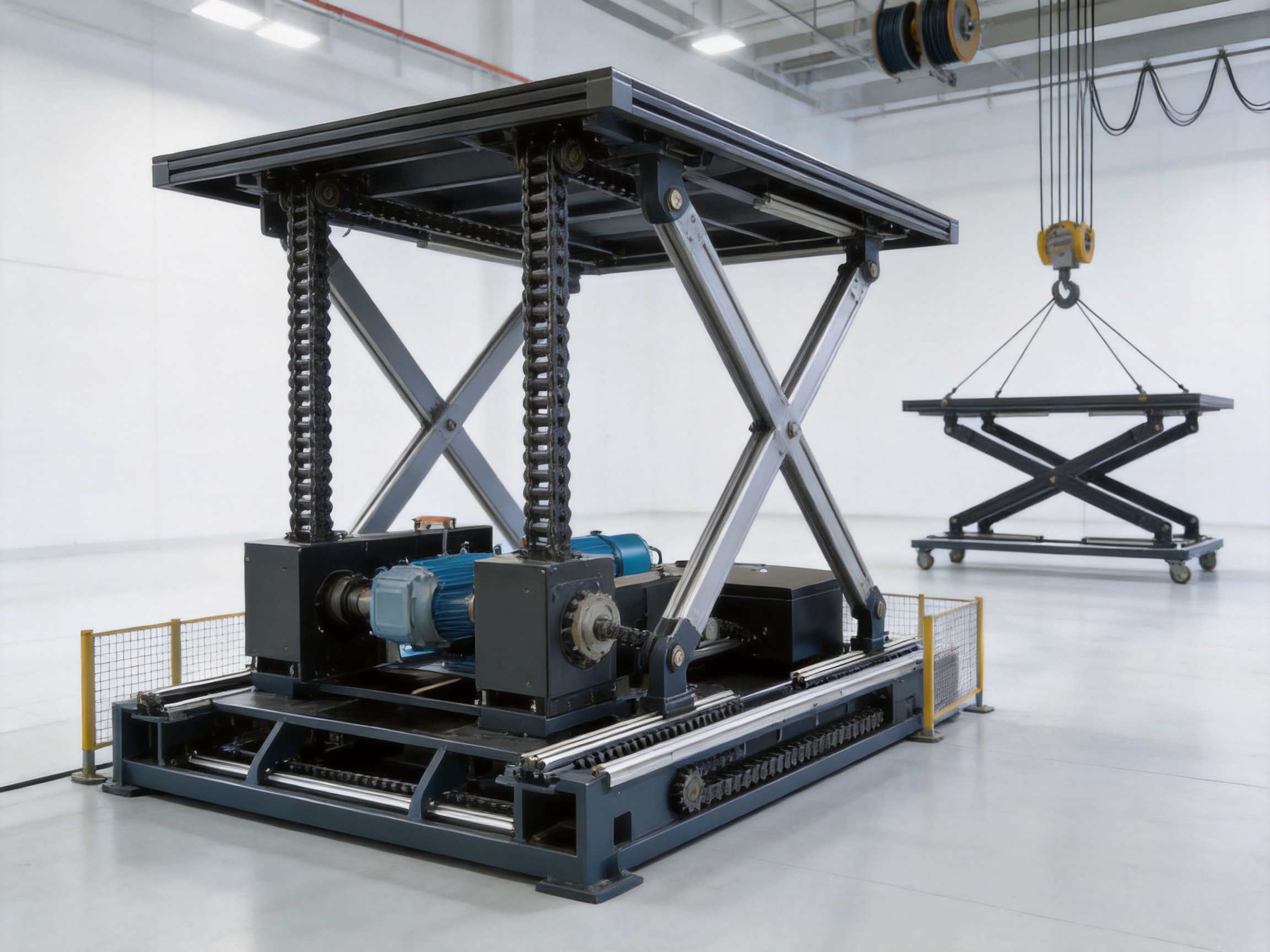
A rigid chain lift table is a vertical platform-lifting system that uses an interlocking chain to transfer force. As the chain extends, it forms a self-supporting column capable of pushing the platform upward as well as pulling it downward or supporting movement in the opposite direction. The system also includes a motor, reducer, guidance components, platform structure, and support elements.
A cable lift primarily uses a flexible member in tension and may require overhead drums, sheaves, or suspension points. A rigid chain lift can push as well as pull and can be arranged without relying on a conventional overhead lifting point. It may also provide a more direct and firm force path for a stage platform.
The standard lifting velocity is up to 150 mm/s. The appropriate operating speed for a particular project depends on load, platform dimensions, travel, chain configuration, control settings, and the required motion profile.
Yes, the system can be configured with single, double, or multiple synchronized chains according to the platform and load requirements. The final configuration must be engineered for the actual payload, dimensions, travel, and support conditions.
Synchronization ensures that each chain extends and retracts at a matched rate. Without synchronization, one side of the platform could move faster than another, causing tilting, uneven load distribution, mechanical stress, and inaccurate positioning.
Linear guides constrain the platform to a defined vertical path. They help prevent lateral drift and improve the accuracy of alignment between the moving platform and the surrounding stage.
X-tracing supports help resist twisting and racking forces, especially when a load is positioned away from the center of the platform. They work with the guides and rigid chain to improve structural stability.
Yes. The system is compatible with digitalized control systems and inverter control. Integration should be planned according to the venue’s control architecture, operating modes, signal requirements, emergency functions, and positioning needs.
The lift table is intended for stage and performance applications, but suitability depends on the project-specific design, rated load, platform construction, safety equipment, operating procedures, and applicable regulations. The platform must be engineered and commissioned for the intended use before performers are permitted to occupy it.
The rigid chain’s push-pull capability allows the mechanism to drive the platform from below, so a conventional overhead lifting point may not be necessary. The final installation still requires suitable structural support and adequate space for the complete lift assembly.
Maintenance should include inspection of the chain, chain box, motor, reducer, guides, platform frame, X-tracing supports, fasteners, control functions, limits, and emergency devices. The frequency and scope should follow the project documentation, operating conditions, and applicable safety requirements.
Customers should provide platform dimensions, total moving mass, rated payload, travel distance, desired speed, operating frequency, chain configuration preference, installation restrictions, control-system requirements, and intended venue application. Clear information allows the manufacturer to propose a suitable configuration.
RenteZhihe provides a service system covering design, production, installation, commissioning, operation, and maintenance. Project support should be coordinated according to the specific scope and requirements of the venue.
The Rigid/Screw/Rack/Chain Lifting Chain Lift Table provides a practical solution for stage-level elevation where precision, stability, compact integration, and automation compatibility are essential. Its rigid chain mechanism can push as well as pull, reducing dependence on conventional overhead cable arrangements and creating a direct mechanical connection between the drive system and platform.
The modular use of single, double, or multiple chains allows the lift to be adapted to different platform sizes and load conditions. Synchronized chain operation helps maintain level movement, while linear guides control the vertical path and X-tracing supports resist twisting and racking. Together, these elements create a more complete lifting system than a chain mechanism considered in isolation.
With a standard lifting velocity of up to 150 mm/s, smooth motion, constant force and speed output, and compatibility with digital and inverter control, the lift table is suited to modern automated venues. It can support theaters, cultural centers, stadiums, conference facilities, and multifunctional performance spaces.
The product’s value is strengthened by the manufacturer’s integrated capabilities. RenteZhihe combines research and development, manufacturing, installation, commissioning, operation, and maintenance support. This lifecycle approach helps connect engineering design with practical venue requirements and long-term service.
For customers planning a new stage automation system or upgrading an existing venue, the key consideration is not simply how fast a platform can move. The more important question is whether the entire lifting system can deliver stable, repeatable, accurately guided, and safely controlled movement over years of operation. The rigid chain lift table is designed to meet that broader requirement.
1. RenteZhihe (JiangSu) Equipment Technology Co., Ltd., Product Information: Rigid/Screw/Rack/Chain Lifting Chain Lift Table.
2. RenteZhihe (JiangSu) Equipment Technology Co., Ltd., Company Profile and Stage Machinery Service Information.
3. General principles of mechanical power transmission, reduction drives, and guided vertical lifting systems.
4. General engineering practices for stage machinery design, installation, commissioning, operation, and maintenance.
5. General principles of automated motion control, inverter-based motor control, and synchronized multi-drive systems.
We specialize in delivering advanced stage machinery, rigging systems and intelligent control solutions for performance spaces worldwide.

No. 111 Runfeng Road, Hailing District, Taizhou City, Jiangsu Province, China

rtstage@163.com

+86-139 1771 1698

+86-139 1771 1698
rtstage@163.com
 中文简体
 English
 русский
 Français
 Español
 عربى