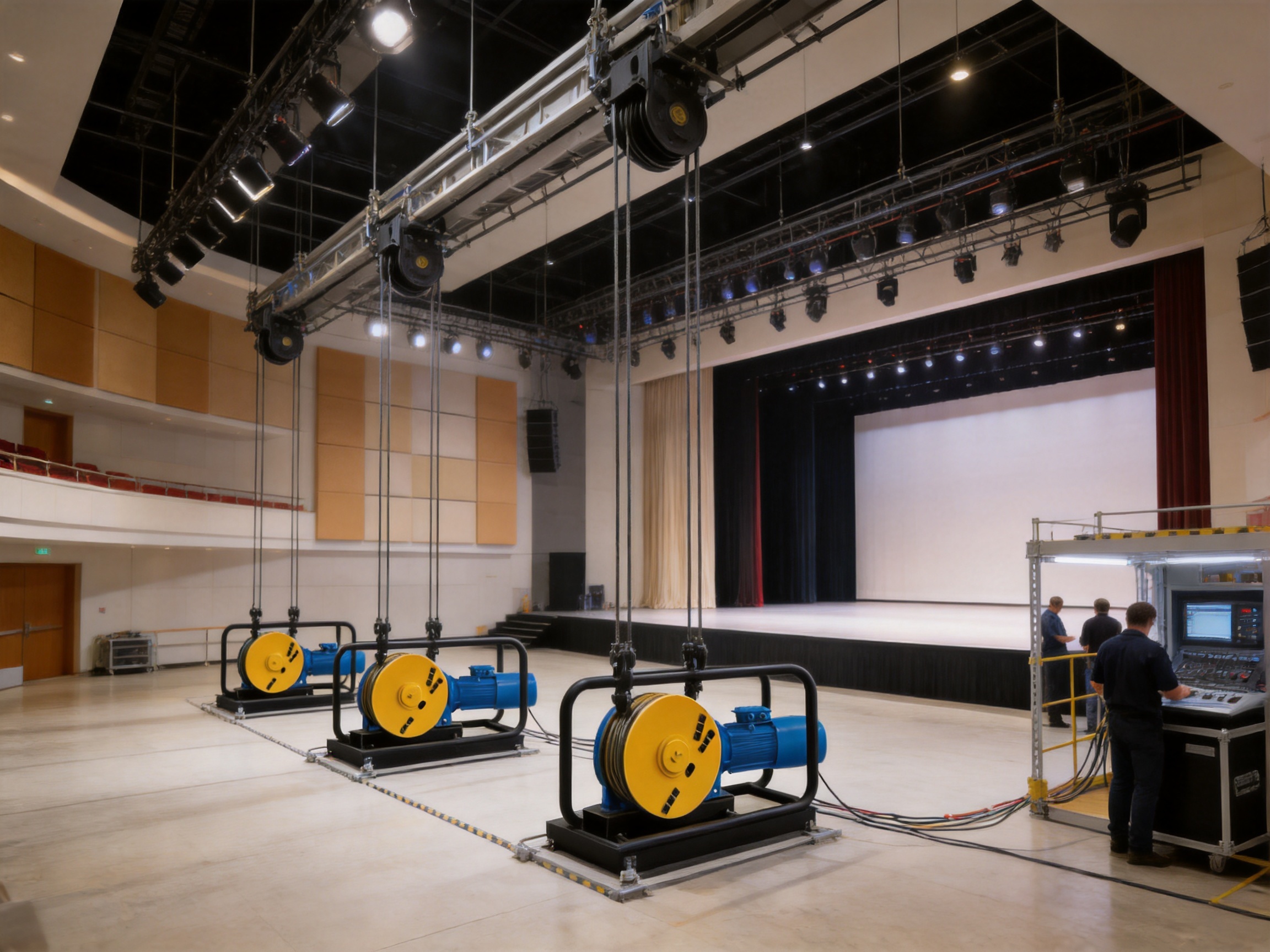
Modern performance venues require lifting equipment that is compact, accurate, dependable, and safe under repeated operating cycles. Stage curtains, lighting systems, scenery, acoustic panels, banners, and other suspended equipment may need to be raised and lowered many times during rehearsals, performances, maintenance, and venue conversion. In these applications, the winch is not simply a motorized winding device. It is a critical part of the venue’s mechanical, electrical, and safety infrastructure.
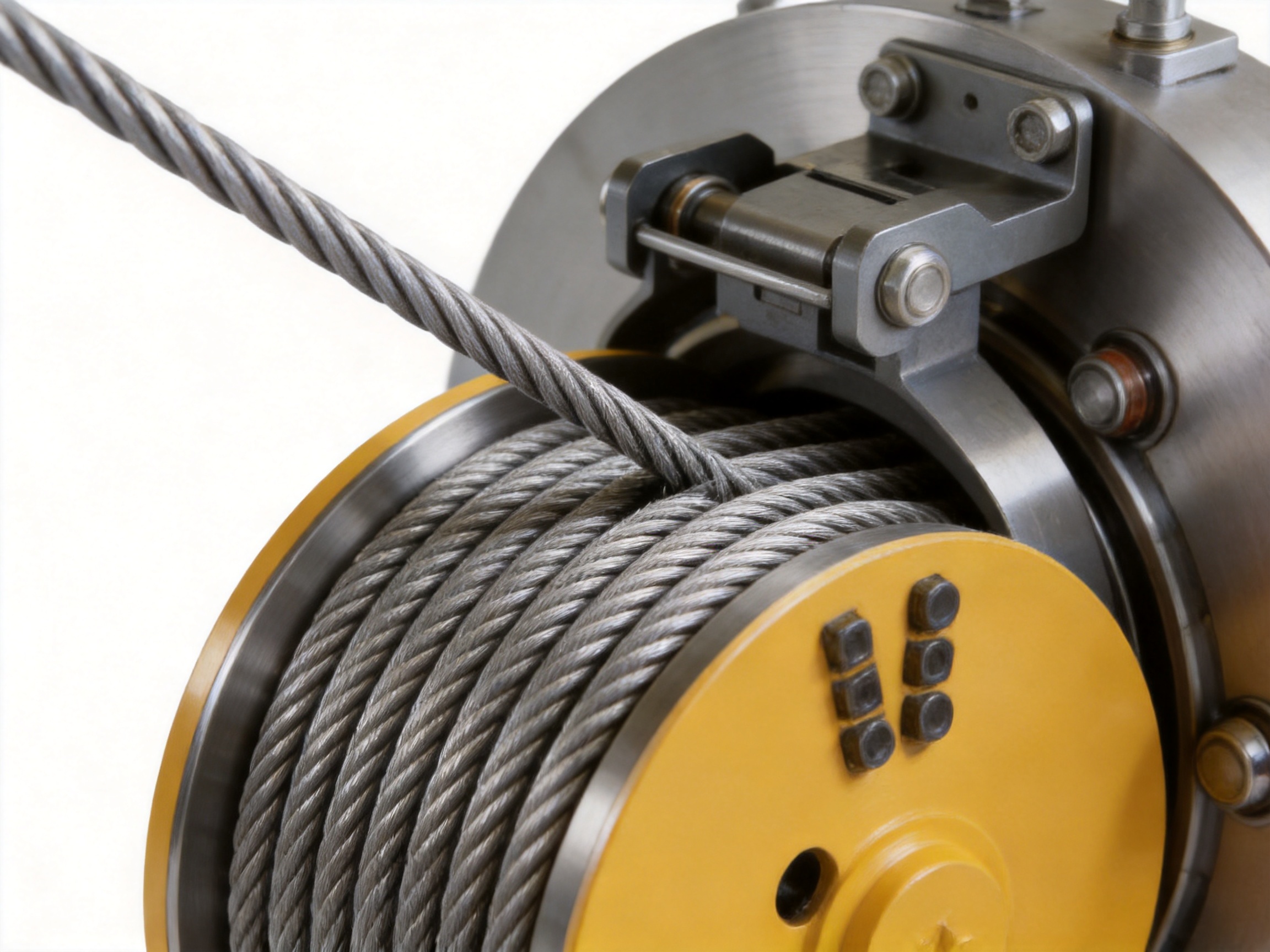
The PI-Series Self-Aligning Pilewind Stage Winch is designed to address one of the most persistent problems in conventional stage lifting systems: disordered wire rope winding. Its patented pilewind assembly guides the rope into a controlled and orderly winding pattern, helping to reduce crossover, friction, lateral loading, and unnecessary bending. This design supports stable lifting performance while helping extend wire rope service life and reduce maintenance requirements.
Unlike many conventional drum winches that depend on a fixed winding path, the self-aligning pilewind design automatically manages the position of the cable as the drum rotates. This feature allows the winch to maintain more consistent winding during repeated lifting cycles, even in stage environments where equipment must operate frequently and with high positioning accuracy.
The product also combines a compact frame-mounted structure, lightweight construction, dual external brakes, motor self-locking technology, limit switching, and payload inspection sensors. These features make the winch suitable for permanent installations as well as touring productions, temporary venues, exhibition halls, cultural centers, television studios, concert halls, and other spaces where fast installation and dependable operation are important.
Wire rope is a highly engineered lifting component, but its service life depends greatly on how it is handled. A cable may be manufactured from high-strength steel and still suffer premature wear if it is repeatedly wound unevenly, forced across adjacent layers, exposed to excessive side pressure, or bent at an inconsistent angle.
In stage machinery, cable management is especially important because lifting cycles can be frequent and precise. A winch may be required to move a suspended load smoothly to a defined position, stop at a repeatable height, and remain stable during a performance. If the rope winds irregularly, the effective winding diameter can change unexpectedly. This may affect travel accuracy, tension distribution, and the smoothness of the lifting motion.
Disordered winding can also create localized pressure points. When one part of a rope crosses another, the contact area becomes smaller and the pressure becomes higher. Repeated contact may cause abrasion, deformation, flattened strands, or accelerated fatigue. In serious cases, uneven winding can affect the load path and increase the demands placed on the motor, reducer, bearings, and brake system.
The PI-Series winch addresses this issue at the mechanical source. Its pilewind assembly is designed to guide the wire rope into an orderly pattern, helping each layer remain aligned with the intended winding path. Instead of allowing the rope to move freely across the drum, the mechanism supports controlled and repeatable placement throughout the lifting process.
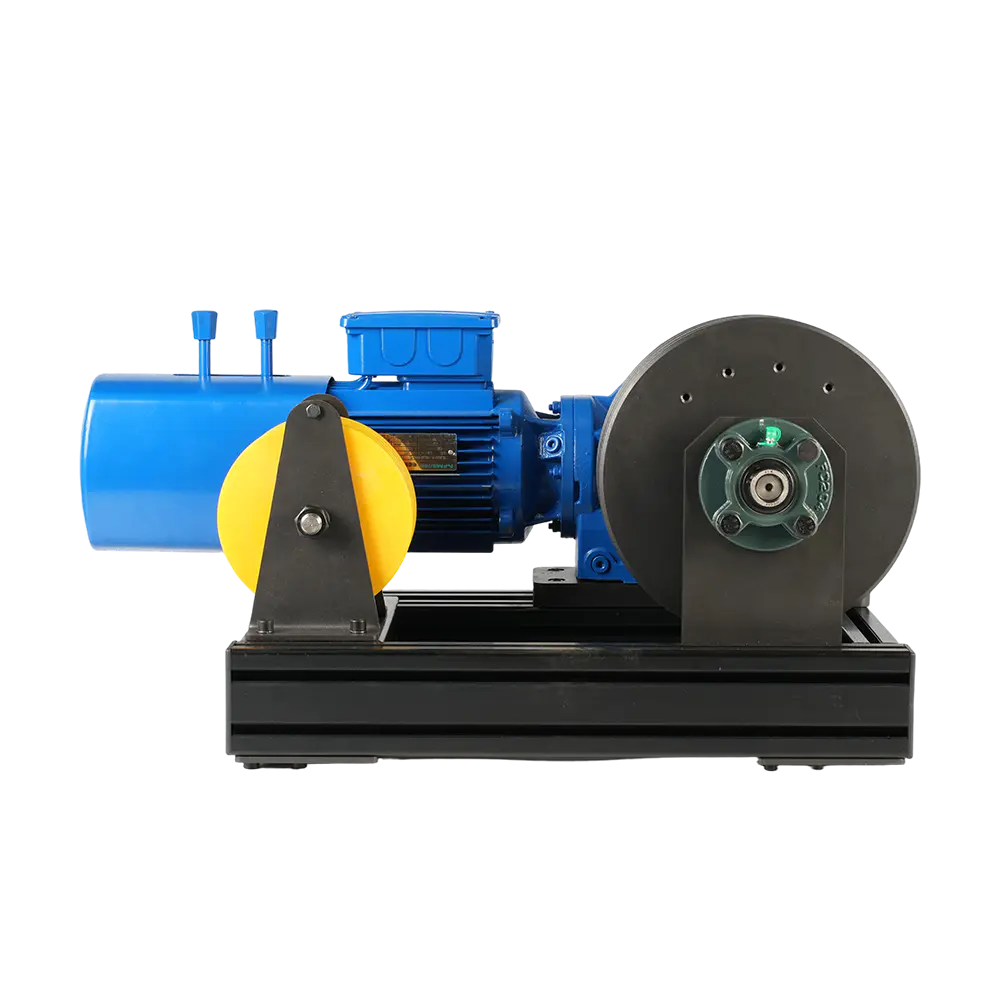
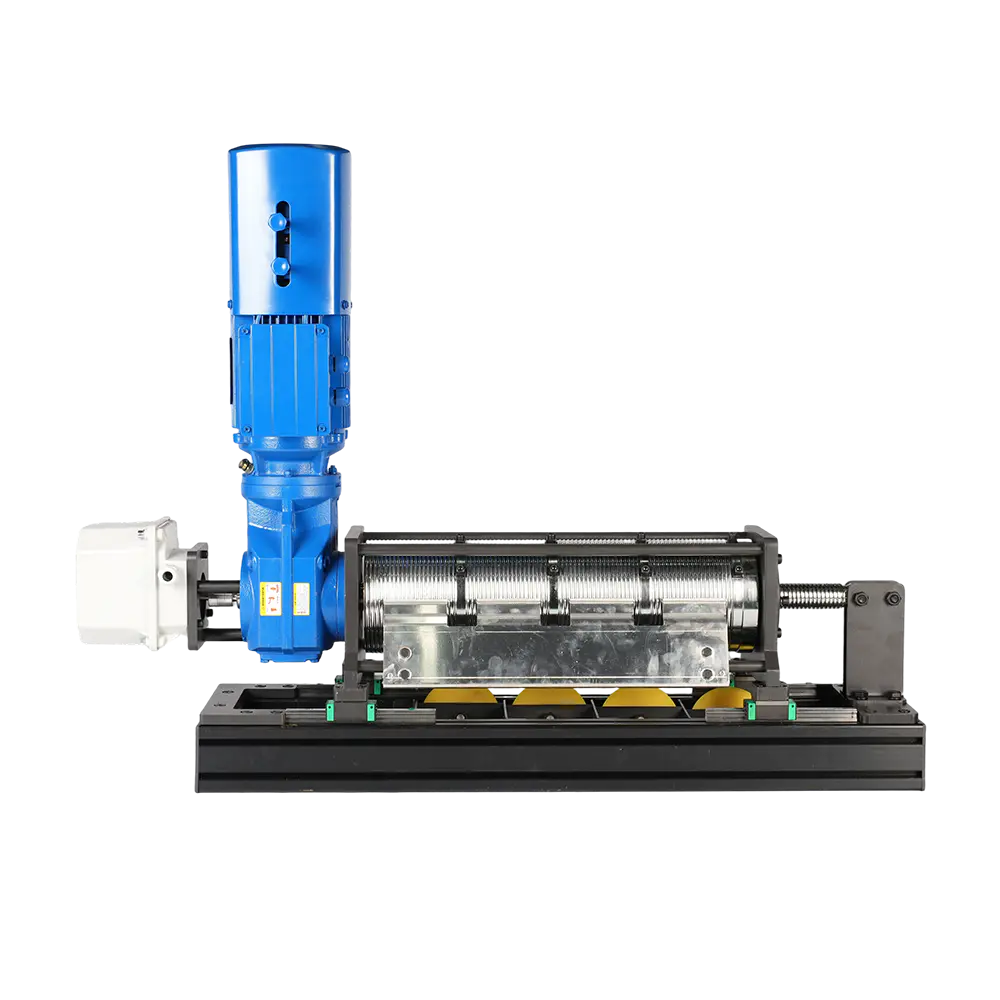
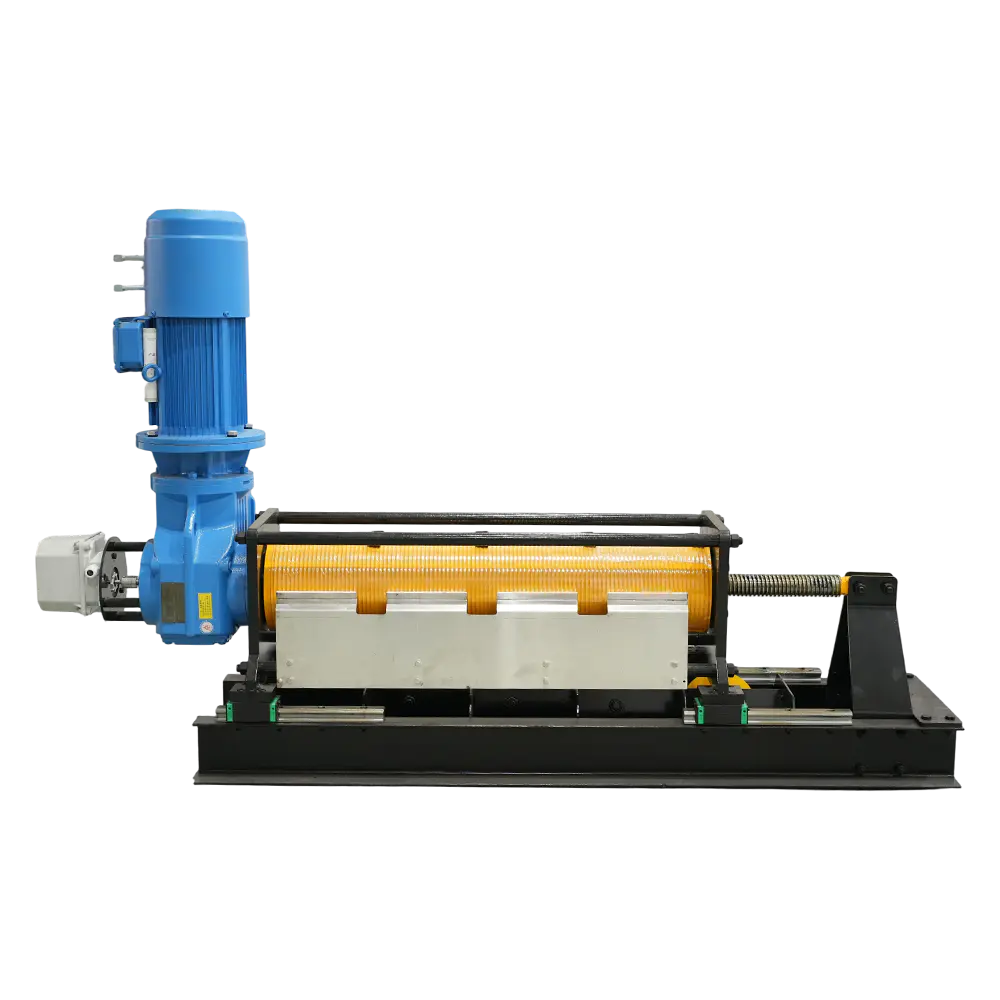
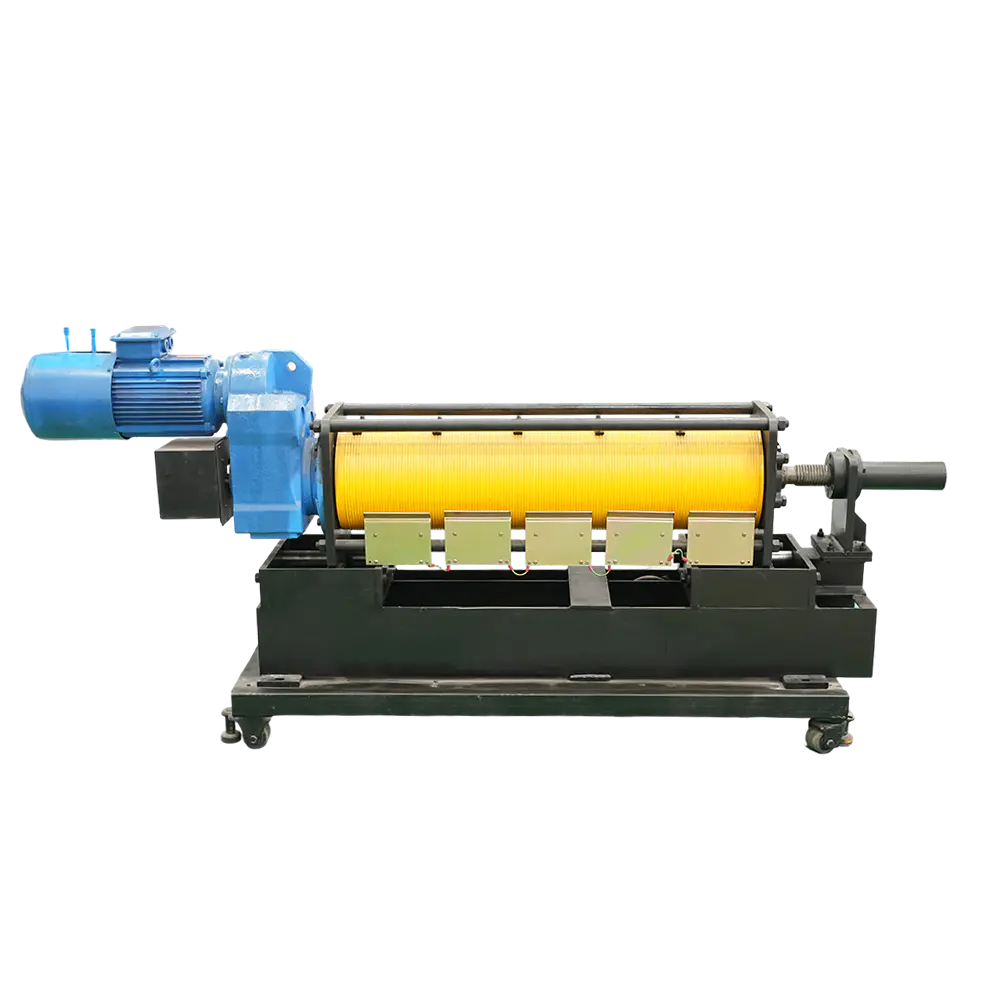
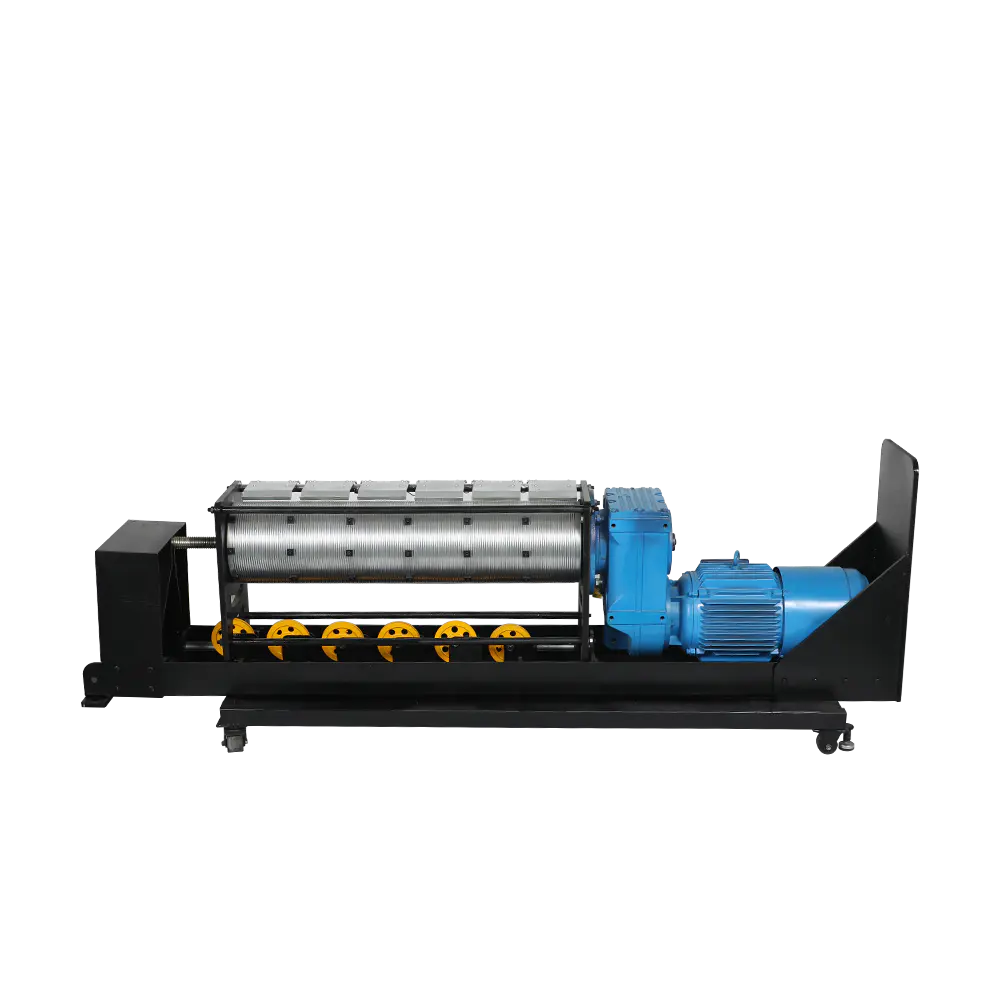
The PI-Series Self-Aligning Pilewind Stage Winch is a frame-mounted stage lifting unit developed for applications requiring organized rope winding, compact installation, and dependable load control. Its principal mechanical components include the mounting frame, electric motor, reducer, pilewind assembly, and limit switch.
The mounting frame provides the structural foundation for the equipment. It supports the motor, transmission system, winding assembly, and associated components as one integrated unit. This frame-mounted arrangement reduces the need for complex site fabrication and allows the winch to be installed in a variety of stage machinery configurations.
The electric motor provides the driving force for lifting and lowering. Working with the reducer, it converts electrical energy into controlled rotational output suitable for the pilewind assembly. The reducer helps provide the required speed and torque characteristics for stage lifting, while also supporting smoother operation during acceleration, travel, and stopping.
The pilewind assembly is the defining feature of the product. It is designed to guide the wire rope into an orderly winding formation rather than relying solely on a conventional drum surface. This approach helps prevent irregular stacking and supports more stable cable behavior across repeated operating cycles.
The limit switch provides travel control and helps define the permitted operating range. When integrated into a properly designed control system, it can help prevent overtravel and support repeatable end positions. The winch can also be combined with payload inspection sensors and other control or monitoring devices to support emergency shutdown and operational supervision.
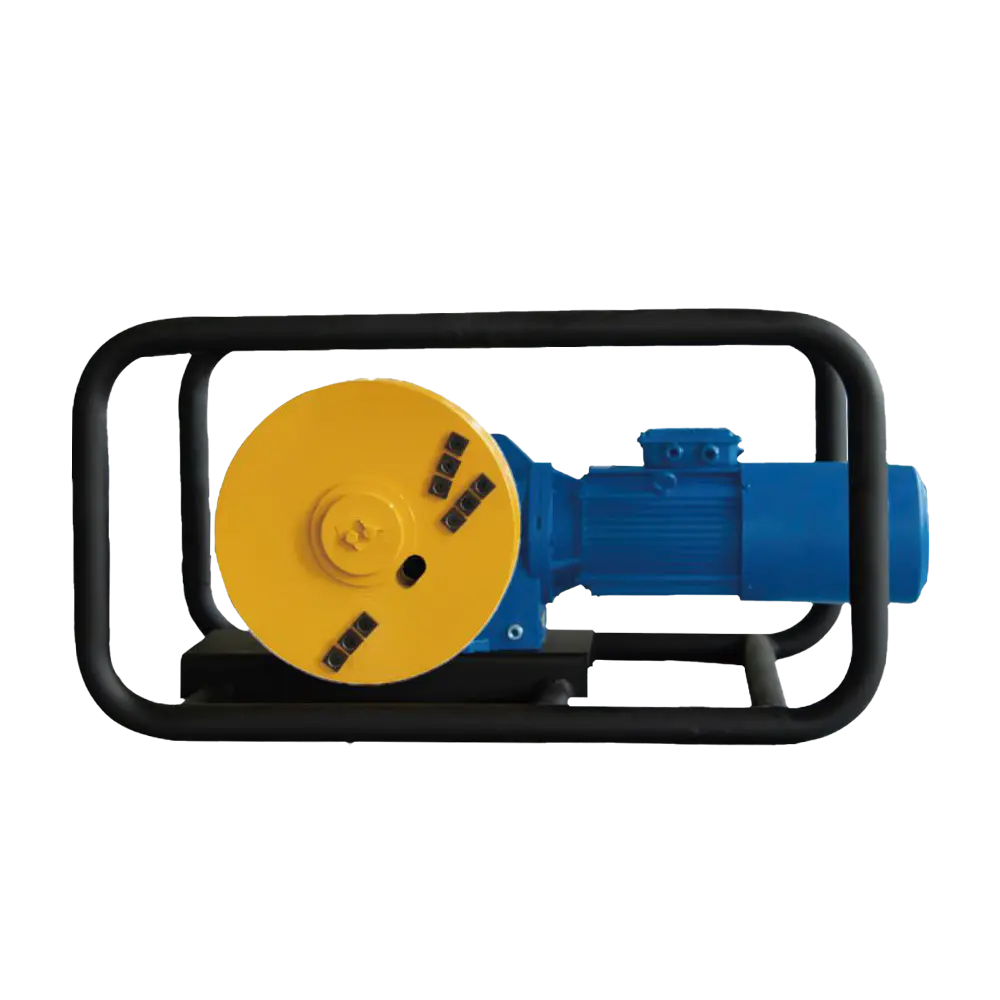
PI-Series Self-Aligning Pilewind Stage Winch
The most significant advantage of the PI-Series winch is its patented rope aligning technology. Traditional stage winches often use a standard drum and a fixed cable path. Although this arrangement can be effective in simple applications, it may become less reliable when the rope must be wound and unwound repeatedly under varying loads and operating conditions.
The patented pilewind assembly actively supports the orderly placement of the rope. By guiding the cable as the drum rotates, it helps reduce rope crossover and minimizes the formation of irregular layers. This provides a more consistent winding structure and reduces the likelihood that one section of cable will experience excessive pressure compared with another.
For venue operators, the benefit is not limited to appearance. Orderly winding can improve mechanical consistency, reduce cable abrasion, and make inspections easier. Maintenance personnel can observe the winding pattern more clearly and identify unusual rope behavior before it develops into a serious problem.
Uneven winding may cause several types of cable damage, including surface abrasion, strand deformation, bending fatigue, and localized crushing. The self-aligning design reduces these risks by maintaining a more stable cable path and distributing contact between winding layers more evenly.
When the cable is aligned correctly, adjacent layers are less likely to rub against each other in an uncontrolled manner. The rope can also enter the winding area at a more consistent angle, reducing unnecessary bending. These improvements help preserve the flexibility and structural condition of the wire rope.
Reduced cable wear may provide several practical benefits. It can extend inspection intervals when permitted by the applicable maintenance program, reduce unplanned replacement, lower downtime, and improve confidence in the lifting system. Actual service life will depend on the rope specification, load, duty cycle, environment, lubrication, installation quality, and inspection procedures, but effective winding control provides an important foundation for durability.
The PI-Series winch uses a compact, modern frame-mounted structure. This is valuable in stage environments where overhead space, machinery galleries, loading areas, and access routes may be limited. A smaller installation footprint can simplify equipment planning and make it easier to integrate the winch into existing stage infrastructure.
Its lightweight design is particularly useful for touring shows and temporary installations. Touring productions often need to transport, install, commission, operate, dismantle, and reinstall equipment within tight schedules. Equipment that is easier to handle can reduce installation labor and support faster venue changeovers.
Compact construction does not mean that safety or functionality is sacrificed. The product integrates the motor, reducer, pilewind assembly, frame, and limit switch into a coordinated system. This helps reduce unnecessary external mechanisms and supports a cleaner installation arrangement.
The winch is equipped with dual external brakes that provide an additional level of stopping and holding capability. A dual-brake configuration can improve system redundancy and increase the safety factor when lifting suspended stage equipment.
Brakes are essential for maintaining load position when the motor is not actively driving the winch. They must be correctly selected, adjusted, inspected, and maintained according to the equipment design and the applicable safety requirements. The presence of two external brakes provides a visible and serviceable arrangement that can support inspection and maintenance activities.
The brake system works together with the motor self-locking technology. This combination is intended to provide layered protection rather than relying on a single protective measure. In a stage lifting system, multiple independent or complementary safety functions are valuable because the consequences of uncontrolled movement can be serious.
The PI-Series winch incorporates motor self-locking technology designed to help prevent payload dropping, including in a brake-failure scenario. This function provides an additional mechanical safeguard by helping resist unwanted movement when the normal braking function is compromised.
Self-locking technology is particularly important in applications where the load remains suspended for extended periods. Lighting equipment, scenery, curtains, and other stage components may need to remain in position while personnel work nearby or while a performance is underway. A self-locking mechanism can help improve load-holding security, although it must always be used as part of a complete safety system and not as a substitute for proper engineering, inspection, and operational procedures.
The combination of self-locking transmission characteristics, dual external brakes, limit control, and emergency monitoring gives the product a multi-layered approach to stage lifting safety. This is a meaningful advantage over basic winches that depend primarily on a single brake or a simple motor stop command.
Payload inspection sensors are designed to halt operation immediately when an emergency condition is detected. These sensors can form part of the monitoring architecture for the winch and help provide a rapid response when an abnormal payload condition or other designated emergency signal occurs.
In automated stage machinery, fast response is important. A control system must not only execute normal movement commands but also recognize conditions that require an immediate stop. Payload monitoring can support this objective by providing additional information to the control system and helping prevent continued operation when the system detects a potentially unsafe condition.
Sensor configuration and emergency logic should be determined according to the specific project design, payload characteristics, control architecture, and applicable regulations. The important advantage of the PI-Series platform is that its mechanical design can be integrated with monitoring and emergency control functions instead of treating the winch as an isolated motorized drum.
A self-aligning pilewind stage winch is designed around the relationship between drum rotation, cable position, winding direction, and load tension. As the drum turns, the pilewind assembly guides the cable so that it is placed in a controlled sequence. The rope is not left to form an unpredictable pile. Instead, the mechanism supports a more organized winding profile.
The guide movement is coordinated with the rotational motion of the winding assembly. This allows the rope to move progressively along the intended winding area and return in an orderly manner when the direction changes. The objective is to maintain a stable cable path and avoid unnecessary crossover between adjacent sections.
Orderly winding improves the relationship between the effective drum diameter and the amount of cable wound onto the assembly. This can help support more predictable lifting behavior and improve positioning consistency. It also reduces the chance that an isolated section of rope will be trapped, crushed, or forced against another layer.
The alignment mechanism does not eliminate the need for correct installation or maintenance. The rope must still be selected for the application, installed correctly, kept within its permitted operating limits, and inspected regularly. However, by controlling the winding process, the winch reduces one of the main sources of mechanical stress found in conventional arrangements.
When a cable winds unevenly, the load may become concentrated at specific contact points. Such concentration can increase pressure on the rope, drum, guide surfaces, bearings, and transmission components. A self-aligning winding pattern distributes the cable more evenly across the available winding area.
More balanced load distribution helps reduce localized deformation and may support more consistent mechanical performance. It also helps the rope remain in a predictable position when the load is accelerated, stopped, or held stationary.
Rope crossover creates rubbing and sliding between adjacent cable sections. This friction may remove protective surface treatment, generate heat, and accelerate wear. The pilewind design reduces uncontrolled crossover and supports even contact between layers.
Lower friction can help preserve the condition of galvanized or stainless steel wire ropes. It may also support better retention of suitable lubrication, depending on the rope construction and maintenance method. Reduced friction benefits the entire lifting system because it can lower unnecessary resistance during winding and unwinding.
The point where the cable enters the winding assembly is a critical area of mechanical stress. A changing or excessive entry angle may force the rope to bend repeatedly in an inconsistent manner. Over time, this can contribute to fatigue and loss of flexibility.
The self-aligning system helps maintain a more stable cable entry position. By guiding the rope progressively and keeping it aligned with the winding path, the system can reduce unnecessary lateral movement and bending. This contributes to smoother operation and more predictable rope behavior.
Loose winding can occur when cable tension is inconsistent. A loose section may later tighten suddenly, creating a shock load or irregular cable placement. The controlled pilewind process helps maintain a more orderly relationship between cable position and tension.
Consistent tension supports accurate positioning, reduces vibration, and improves the quality of repeated lifting cycles. It can also help the control system achieve more stable movement, particularly when the winch is integrated into synchronized stage automation.
Maintenance costs include more than replacement parts. They also involve labor, inspection time, production interruptions, access equipment, and the risk of postponing performances or venue activities. By reducing the mechanical conditions that accelerate cable wear, the PI-Series winch can help reduce the frequency of corrective maintenance.
Its compact arrangement and visible external braking components can also support easier inspection. Maintenance personnel can access the principal mechanical systems according to the installation design, inspect the rope path, check the brake condition, and verify the limit switch without dealing with unnecessarily complex winding arrangements.
Safety in stage lifting is achieved through the coordination of mechanical, electrical, control, and procedural measures. No single component should be considered sufficient on its own. The PI-Series design reflects this principle by combining several safety-related features within one lifting platform.
| Safety or Control Feature | Primary Function | Operational Benefit |
|---|---|---|
| Dual external brakes | Stop and hold the suspended load | Provides additional braking redundancy and a higher safety factor |
| Motor self-locking technology | Resist unintended movement | Helps prevent payload dropping if the normal brake function fails |
| Limit switch | Define travel limits | Supports repeatable end positions and helps prevent overtravel |
| Payload inspection sensors | Monitor designated emergency conditions | Can stop operation immediately when an abnormal condition is detected |
| Self-aligning pilewind assembly | Control cable placement | Reduces crossover, friction, and irregular winding |
| Mounting frame | Support integrated components | Improves installation organization and structural stability |
These features are most effective when incorporated into a complete project safety plan. The final system should include suitable load calculations, structural verification, electrical protection, emergency stop circuits, control interlocks, installation checks, commissioning procedures, and scheduled inspections.
Operators should be trained to recognize unusual noise, vibration, cable deformation, brake delay, unexpected movement, sensor alarms, and other warning signs. Any abnormal condition should be investigated before the equipment returns to service.
The performance of a stage winch depends not only on its concept but also on the quality of its manufacturing process. Precision alignment, reliable welding, accurate machining, correct assembly, proper electrical integration, and systematic testing all contribute to long-term performance.
RenteZhihe (Jiangsu) Equipment Technology Co., Ltd. specializes in the research, development, and manufacturing of stage machinery, performance equipment, and intelligent control systems. The company provides integrated services covering equipment design, production, installation, commissioning, operation, and maintenance.
This full-service capability is valuable because stage machinery is project-oriented equipment. A winch must often be adapted to the venue’s available space, load requirements, control system, installation method, and performance schedule. A manufacturer capable of supporting the equipment from design through commissioning can identify practical issues earlier and coordinate the different stages of delivery more effectively.
The PI-Series product reflects an engineering approach focused on practical stage automation problems. Instead of simply increasing motor power, the design addresses cable control, installation footprint, safety redundancy, and touring requirements. The patented rope aligning technology is an example of product development driven by a specific operational challenge.
Research and development in stage machinery must consider the interaction between mechanical movement and control logic. A winch must be able to move the load, stop accurately, hold the load safely, respond to emergency commands, and operate repeatedly without creating excessive stress. The company’s focus on intelligent control systems supports the integration of these functions into broader venue automation projects.
The company’s production base covers approximately 20,000 square meters. It includes an approximately 11,000-square-meter modern manufacturing workshop and an approximately 7,500-square-meter research and development and office facility.
A production base of this scale allows the company to organize material processing, component fabrication, assembly, testing, and project coordination within a structured manufacturing environment. The complete production and processing system supports the manufacturing process from raw material preparation to complete machine assembly.
Centralized production helps improve coordination between engineering and manufacturing personnel. Drawings, component requirements, assembly procedures, inspection records, and project-specific modifications can be managed more effectively when the relevant functions work within an integrated organization.
Material selection is important for both the frame and the moving components. Structural steel provides the rigidity required for the mounting frame, while high-strength steel can be used in load-supporting drum and mechanical components. Precision alloy steel is suitable for bearings and other components that require smooth rotation and dimensional stability.
Wear-resistant materials may be used in cable guide areas to reduce friction and protect the rope path. Galvanized or stainless steel wire ropes may be selected according to the environmental conditions, corrosion requirements, load characteristics, and project specifications.
Material control should include verification of incoming components, identification of relevant material grades, dimensional checks, and confirmation that parts meet the design requirements. These activities help reduce variation and support consistent product quality.
The mounting frame must maintain sufficient strength and alignment under operating loads. Fabrication quality therefore affects more than appearance. Weld preparation, welding sequence, dimensional control, distortion management, and post-weld inspection can all influence the final geometry of the equipment.
A stable frame helps the motor, reducer, pilewind assembly, and braking components remain correctly positioned. If the frame is distorted or inaccurately assembled, the cable path may be affected and the mechanical load may not be distributed as intended.
Machined parts must meet the dimensional and surface requirements necessary for smooth rotation, reliable engagement, and stable cable guidance. Bearings, shafts, couplings, guide components, and reducer interfaces require accurate assembly to limit vibration and unnecessary mechanical resistance.
During assembly, technicians must verify the relationship between the motor, reducer, winding assembly, brakes, limit switch, and frame. Correct alignment is particularly important for a self-aligning pilewind mechanism because the guide movement must correspond properly with drum rotation.
Assembly procedures should include torque control for critical fasteners, lubrication of designated components, verification of moving clearances, inspection of cable routing, and confirmation that protective covers and safety elements are correctly installed.
Testing is an essential part of stage winch manufacturing. Functional testing may include motor operation, reducer performance, braking action, self-locking behavior, limit switch response, sensor response, winding alignment, and emergency stop behavior.
Where required by the project, testing may also include no-load operation, controlled load testing, repeated cycling, stopping accuracy, abnormal-condition simulation, and inspection after operation. The exact testing program should be based on the equipment design, specified payload, duty cycle, installation environment, and applicable standards.
A complete quality assurance process creates traceability from raw materials and components through final assembly. It can include production records, inspection documents, testing reports, commissioning records, and maintenance recommendations. This documentation supports project acceptance and provides useful information for future service activities.
Touring productions face different challenges from permanent theaters. Equipment must be transported between venues, installed under time pressure, adapted to varying stage layouts, and removed without excessive labor. The PI-Series winch’s compact and lightweight frame-mounted structure is designed with these conditions in mind.
A portable winch can simplify logistics because it requires less space for transport and can be handled more easily during installation. A compact structure may also fit into venues where fixed machinery rooms or extensive overhead infrastructure are not available.
The orderly cable winding system is valuable for touring because equipment may be exposed to repeated setup and teardown cycles. Reducing the likelihood of disordered rope storage can help preserve the cable during transport and operation. The external brakes and integrated safety functions also support a more organized inspection process before each production begins.
Touring applications still require professional engineering. The temporary installation must be checked for structural support, power supply, control compatibility, load limits, emergency access, and operator training. The winch’s portability is an advantage, but it does not remove the need for venue-specific verification.
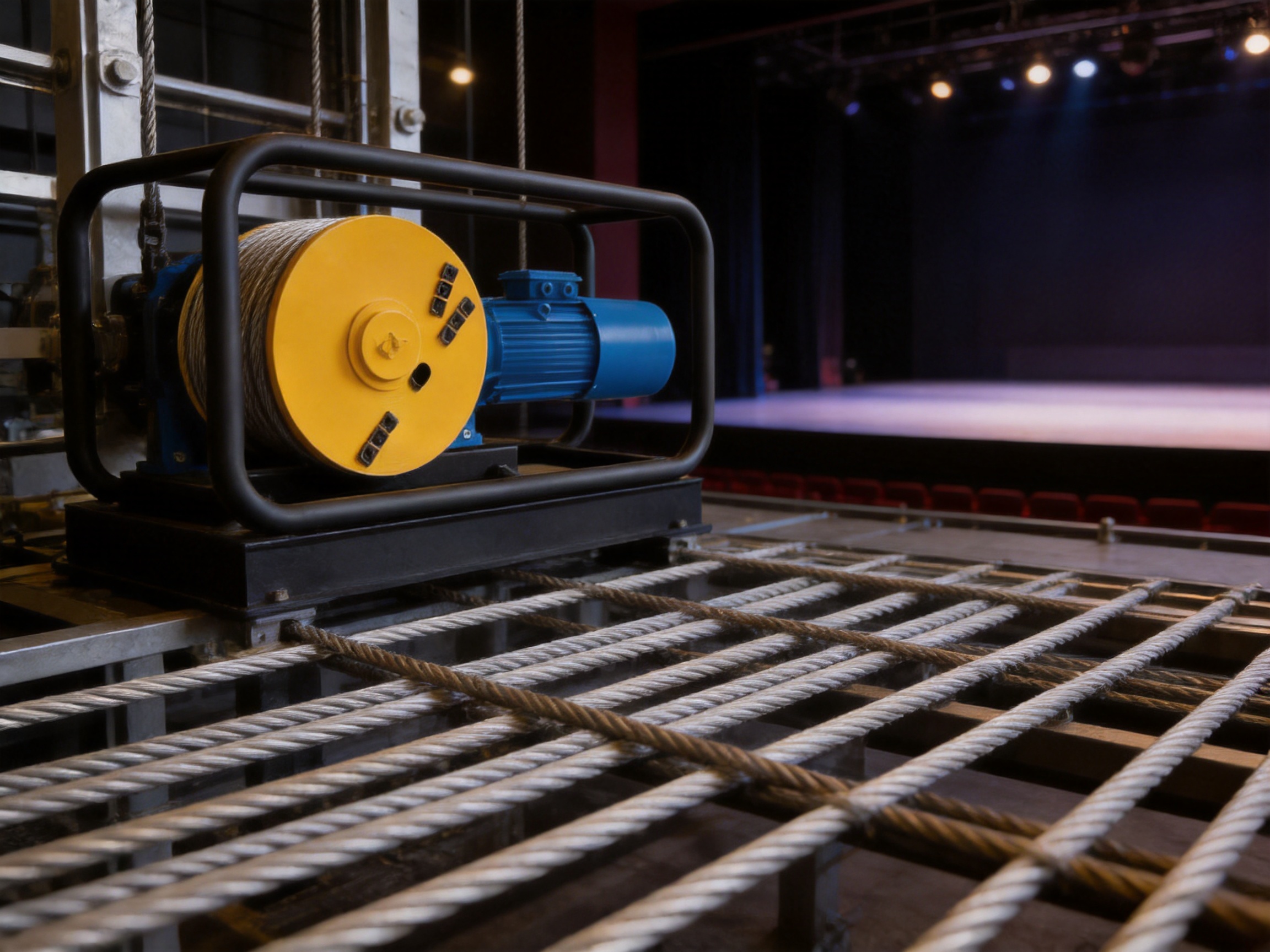
The PI-Series Self-Aligning Pilewind Stage Winch can be used in a wide range of performance and event environments where controlled lifting is required.
In professional theaters, the winch may support scenery, curtains, lighting equipment, acoustic elements, or other stage components. In concert halls, accurate lifting and reliable holding are important for lighting rigs, banners, decorative structures, and event production equipment.
Television studios often require frequent scene changes and flexible equipment arrangements. A compact, precise winch can help support rapid reconfiguration while maintaining orderly cable management. Conference centers and multi-functional venues may also benefit because their spaces are frequently adapted for different events.
Stadium and large event applications require careful attention to structural loads, environmental conditions, access, and control distances. The winch can form part of a larger automated stage machinery system when integrated with suitable control cabinets, sensors, communication systems, and safety interlocks.
Modern stage machinery increasingly depends on centralized control. Operators may need to coordinate multiple winches, monitor positions, set movement sequences, and respond quickly to emergency conditions. A lifting unit must therefore provide reliable mechanical movement while also communicating effectively with the control system.
The PI-Series winch can support intelligent stage automation through its limit switch, payload inspection sensors, motor control, braking system, and self-aligning mechanical design. These elements can provide the information and response functions needed for a coordinated lifting system.
Accurate cable winding is also important for synchronization. If the cable builds up unevenly on one winch but not another, the effective drum diameter may vary between units. This can affect relative travel and create positioning differences. By maintaining a more consistent winding pattern, the pilewind assembly supports more predictable synchronized movement.
Control integration should be designed according to the project’s operational requirements. Important considerations include movement speed, acceleration and deceleration, positioning accuracy, emergency stop behavior, sensor feedback, load monitoring, communication protocol, manual override, access control, and fault reporting.
Intelligent control does not replace mechanical safety. The best systems combine software monitoring with physical protection. The PI-Series winch’s self-locking technology, dual external brakes, and orderly cable management complement electronic control functions and create a more complete equipment platform.
Correct installation is essential to obtaining the intended performance from any stage winch. Before installation, the project team should review the load requirements, lifting height, rope specification, support structure, power supply, control system, access conditions, and emergency procedures.
The mounting frame must be securely fixed to a suitable support structure. The installation should maintain the alignment of the winch with the cable path and ensure that no external structure forces the rope to enter the pilewind assembly at an unsuitable angle.
Electrical installation should be completed by qualified personnel. Motor connections, grounding, protection devices, limit switch circuits, sensor wiring, emergency stop circuits, and control communication must be checked before operation. Cable routing should protect wires from abrasion, excessive bending, heat, moisture, and accidental impact.
Commissioning should begin with visual and mechanical inspection. Technicians should verify fasteners, guards, brake condition, lubrication, rope installation, frame stability, and cable alignment. The winch should then be tested without load or under the conditions specified by the commissioning plan before controlled load operation begins.
During testing, the team should observe startup, acceleration, travel, deceleration, stopping, holding, reversing, and limit operation. The winding pattern should remain orderly throughout the cycle. Abnormal vibration, unusual noise, rope crossover, brake delay, sensor faults, or unexpected movement should be investigated immediately.
Regular maintenance helps preserve safety and performance. Inspection schedules should be based on operating frequency, payload, environmental conditions, duty cycle, manufacturer recommendations, and applicable standards.
The wire rope should be checked for broken wires, corrosion, deformation, flattened sections, birdcaging, kinks, abrasion, lubrication loss, and irregular winding. The pilewind assembly should be inspected for contamination, wear, looseness, and obstruction. The cable guide should remain clean and correctly aligned.
Brakes should be inspected for wear, adjustment, holding performance, and response time. The motor and reducer should be checked for unusual temperature, noise, vibration, oil leakage, or changes in operating behavior. Bearings and rotating components should be lubricated according to the maintenance plan.
Limit switches and payload inspection sensors should be tested regularly. Emergency stop functions, control interlocks, and alarm circuits should be verified rather than assumed to be operational. Maintenance records should identify the date, equipment condition, work completed, replacement parts, test results, and responsible personnel.
Any component that shows damage or abnormal wear should be removed from service or evaluated by qualified technicians. Continued operation with a damaged rope, ineffective brake, defective sensor, or misaligned winding assembly can create unnecessary risk.
Conventional drum winches remain useful in many lifting applications, but they may require additional cable-guiding arrangements to manage repeated winding. If the cable path is not carefully controlled, the rope may cross, pile unevenly, or experience excessive side pressure.
The PI-Series approach integrates the rope alignment function into the pilewind assembly. This creates a more direct solution to the winding problem and reduces dependence on external arrangements that may require additional space or adjustment.
| Performance Area | Conventional Fixed-Path Drum Winch | PI-Series Self-Aligning Pilewind Winch |
|---|---|---|
| Cable winding | May depend heavily on fixed guides and installation accuracy | Uses a patented pilewind assembly to support orderly winding |
| Rope crossover risk | Can increase if alignment or tension changes | Reduced through automatic cable alignment |
| Installation footprint | May require additional guiding equipment | Compact frame-mounted arrangement |
| Portability | Varies by design and supporting equipment | Lightweight structure suited to touring and temporary setups |
| Brake protection | May rely on a single primary brake | Dual external brakes combined with motor self-locking technology |
| Emergency monitoring | Depends on project-specific integration | Designed to support payload inspection sensors and emergency stopping |
| Maintenance visibility | Irregular winding may complicate inspection | Orderly cable placement makes rope behavior easier to observe |
The right choice depends on the project. However, for stage applications involving frequent lifting, limited space, portability, and a strong need for cable control, the self-aligning pilewind concept offers important advantages.
Purchasing a winch from a manufacturer that also develops stage machinery and intelligent control systems can simplify project coordination. The manufacturer can consider the relationship between the lifting mechanism, control system, venue structure, installation method, and maintenance plan.
RenteZhihe provides services from design and manufacturing through installation, commissioning, operation, and maintenance. This enables customers to receive support throughout the equipment lifecycle rather than only at the point of delivery.
An integrated manufacturer can also provide customized solutions. A project may require a particular frame arrangement, control interface, rope specification, installation orientation, travel limit, sensor configuration, or operating sequence. The design should be adapted to the venue rather than forcing the venue to accommodate an unsuitable standard arrangement.
The company’s experience in theaters, cultural centers, stadiums, conference centers, and multi-functional performance spaces supports a practical understanding of different venue conditions. This experience can help identify installation constraints, operating risks, access requirements, and maintenance needs during the design stage.
Stage machinery projects rarely have identical requirements. The lifting load may vary from one venue to another, while the available installation space, travel distance, control architecture, duty cycle, and environmental conditions may also differ.
A customized PI-Series solution can be developed after reviewing the project’s mechanical and operational requirements. Important information may include the rated payload, rope length, lifting speed, number of operating cycles, suspension arrangement, support structure, power supply, control method, emergency stop strategy, and desired installation schedule.
Customization should preserve the essential safety and performance principles of the product. The self-aligning winding system must remain correctly matched to the rope and drum arrangement. Brake capacity, self-locking characteristics, motor power, reducer ratio, limit switch position, and sensor configuration must be selected as a coordinated system.
Project support may include technical drawings, equipment selection, layout planning, installation guidance, commissioning, operator training, maintenance instructions, and after-sales service. These services help ensure that the equipment performs as intended throughout its operating life.
The purchase price of a winch is only one part of its total cost. Lifecycle value also includes installation labor, commissioning time, energy use, inspections, replacement ropes, corrective maintenance, downtime, spare parts, and the consequences of operational interruptions.
The PI-Series design can contribute to lifecycle value by addressing several cost factors at once. Its compact frame may reduce installation complexity. Its lightweight structure may simplify handling. Its orderly winding system may reduce cable wear. Its safety functions may support more reliable operation. Its integrated manufacturing and service capabilities may improve project coordination.
These advantages do not mean that maintenance can be reduced without limits. Stage lifting equipment remains safety-critical and must be inspected and serviced according to a formal program. The value of the product lies in its ability to make correct operation and maintenance more manageable while reducing avoidable mechanical stress.
For venue owners, production companies, and system integrators, a winch that offers predictable performance can also improve scheduling confidence. Fewer cable-related problems and more stable positioning can reduce interruptions during rehearsals, performances, and venue conversions.
Stage machinery may operate in environments with dust, changing humidity, temperature variation, vibration, and frequent human activity. Touring equipment may also experience repeated transportation and handling. These conditions make structural stability, component protection, and maintainability important design considerations.
The use of structural steel for the frame provides a stable base for the equipment. Wear-resistant guide materials and suitable wire rope selection can help address friction and environmental exposure. Protective covers, correct lubrication, and appropriate storage procedures remain necessary for long-term reliability.
Operational reliability is also influenced by how the equipment is used. Operators should avoid exceeding the rated load, bypassing safety devices, operating with a damaged rope, or repeatedly starting and stopping the system under abnormal conditions. Good operating practice allows the mechanical advantages of the self-aligning design to deliver their full benefit.
The PI-Series Self-Aligning Pilewind Stage Winch provides a focused solution to the cable management challenges found in modern stage lifting. Its patented pilewind assembly maintains orderly rope winding, reduces crossover, controls the cable entry path, and supports more consistent tension. These characteristics can help reduce cable wear, improve positioning accuracy, and lower maintenance pressure.
Compared with conventional fixed-path drum winches, the product offers an integrated approach to cable alignment. Its compact and lightweight frame-mounted structure is suitable for touring productions and temporary installations, while its dual external brakes, motor self-locking technology, limit switch, and payload inspection sensors support a multi-layered safety design.
The product is further strengthened by the manufacturing and engineering capabilities of RenteZhihe (Jiangsu) Equipment Technology Co., Ltd. The company operates a production base of approximately 20,000 square meters, including a modern manufacturing workshop and research and development facilities. Its services cover design, production, installation, commissioning, operation, and maintenance, allowing it to support stage machinery projects throughout their lifecycle.
For theaters, concert halls, cultural centers, television studios, stadiums, conference centers, and multi-functional venues, the self-aligning pilewind concept offers a practical combination of cable protection, compact installation, safety support, and automation compatibility. When correctly specified, installed, operated, and maintained, the PI-Series winch can become a dependable part of an intelligent stage machinery system.
A self-aligning pilewind stage winch is a lifting device that uses a guided pilewind assembly to place the wire rope in an orderly pattern as the drum rotates. The alignment mechanism helps reduce rope crossover, uneven winding, friction, and excessive lateral pressure.
The main advantage is its patented rope aligning technology. By controlling cable placement during lifting and lowering, the winch supports more consistent winding and helps reduce the mechanical conditions that contribute to premature wire rope wear.
The winch reduces cable wear by maintaining automatic cable alignment, improving load distribution, reducing friction between rope layers, stabilizing the cable entry angle, and supporting more consistent tension during repeated lifting cycles.
Yes. Its compact and lightweight frame-mounted structure is designed to support portable installation and temporary stage applications. Touring users must still confirm venue compatibility, structural support, power requirements, load limits, and control integration before operation.
The product includes dual external brakes, motor self-locking technology, a limit switch, and support for payload inspection sensors. These features are intended to work together as part of a complete stage machinery safety system.
No. Motor self-locking technology is an additional protective function and should not be treated as a replacement for correctly selected, adjusted, inspected, and maintained brakes. Stage lifting systems require multiple coordinated safety measures.
Payload inspection sensors can monitor designated emergency or abnormal conditions. When an emergency condition is detected, the system can be configured to halt operation immediately. Sensor functions should be defined during project design and commissioning.
Typical applications include professional theaters, performing arts centers, concert halls, cultural centers, conference centers, television studios, stadium performance systems, touring productions, and multi-functional event spaces.
The principal mechanical components include the mounting frame, electric motor, reducer, pilewind assembly, and limit switch. The equipment can also be integrated with brakes, payload inspection sensors, control systems, and other project-specific safety devices.
Maintenance frequency depends on the operating cycle, payload, environment, installation conditions, manufacturer recommendations, and applicable regulations. Regular inspections should include the wire rope, pilewind assembly, brakes, motor, reducer, bearings, limit switch, sensors, fasteners, and control functions.
Yes. Stage machinery projects may require customization of the frame, motor, reducer, rope arrangement, travel limits, sensor configuration, control interface, and installation method. Customization should be based on documented engineering requirements and verified during commissioning.
Manufacturing quality affects structural strength, alignment, winding accuracy, braking performance, operating noise, maintenance requirements, and service life. Accurate fabrication, machining, assembly, testing, and documentation are essential for reliable stage lifting equipment.
1. Product information for the PI-Series Self-Aligning Pilewind Stage Winch, including product features, mechanical components, safety functions, and applications.
2. RenteZhihe (Jiangsu) Equipment Technology Co., Ltd. company profile and manufacturing capability information.
3. General principles of wire rope inspection, maintenance, bending fatigue, abrasion control, and safe handling in lifting equipment.
4. General engineering principles for stage machinery design, suspended load control, emergency stopping, braking systems, and automated venue equipment.
5. General guidance on the design, commissioning, operation, and maintenance of powered lifting equipment used in performance venues.
We specialize in delivering advanced stage machinery, rigging systems and intelligent control solutions for performance spaces worldwide.

No. 111 Runfeng Road, Hailing District, Taizhou City, Jiangsu Province, China

rtstage@163.com

+86-139 1771 1698

+86-139 1771 1698
rtstage@163.com
 中文简体
 English
 русский
 Français
 Español
 عربى