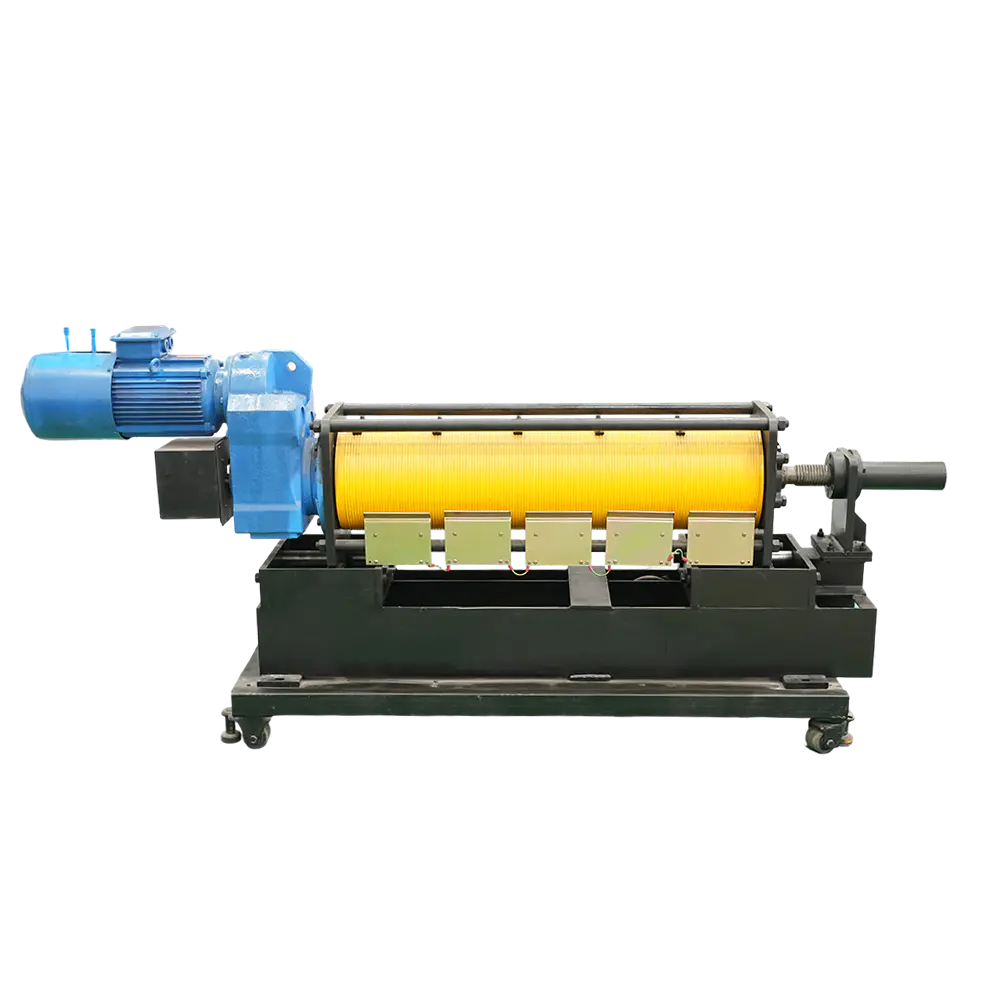
Modern performance venues increasingly depend on lifting systems that can move lighting fixtures, LED screens, scenic elements, and other suspended equipment with accuracy, stability, and repeatable control. As productions become more visually ambitious, the lifting equipment must do more than raise and lower a load. It must coordinate multiple suspension points, protect valuable equipment, support power and communication cables, respond smoothly to control commands, and continue operating reliably through frequent show changes.
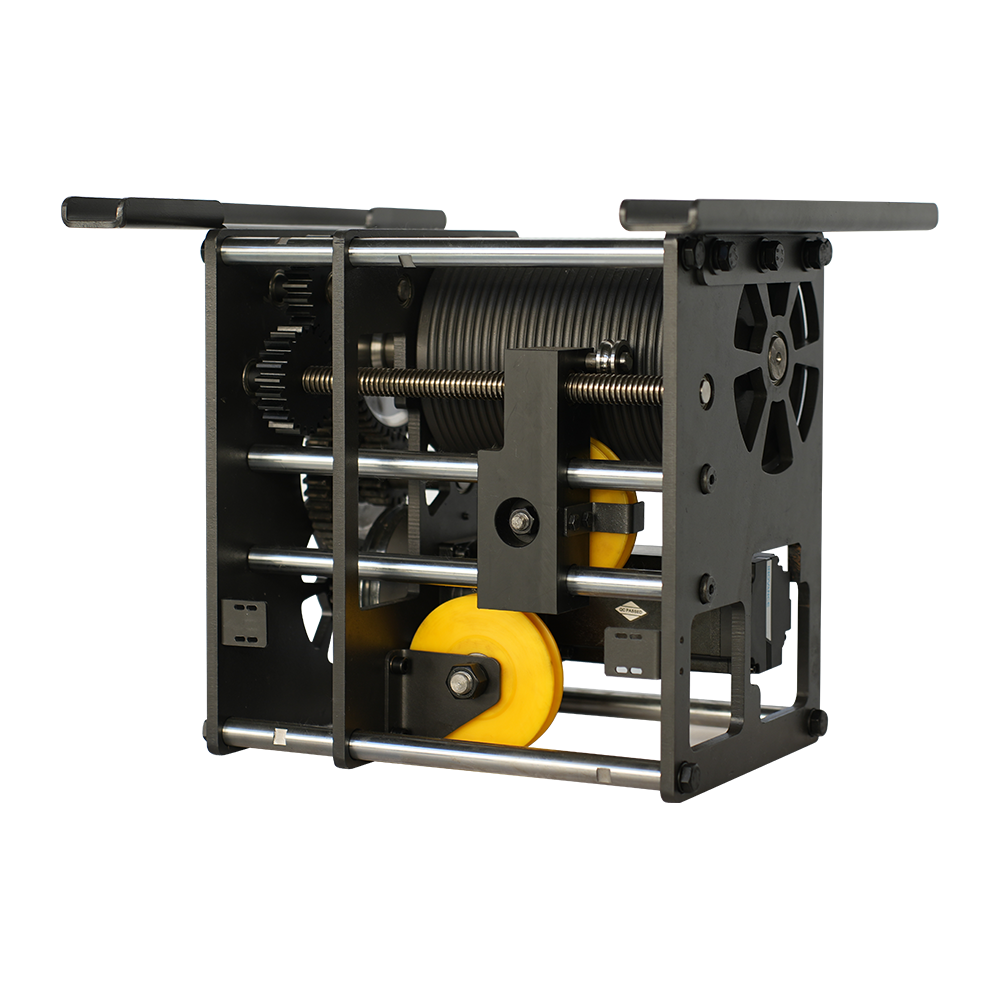
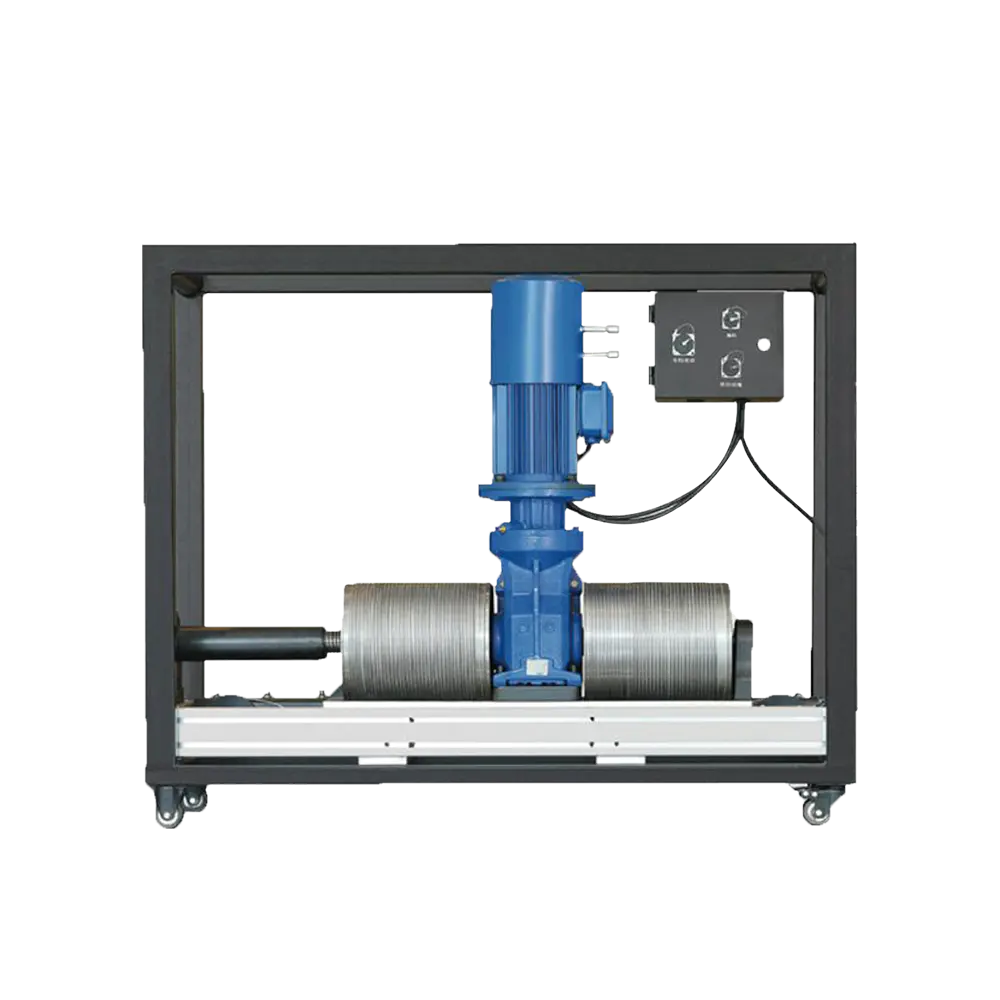
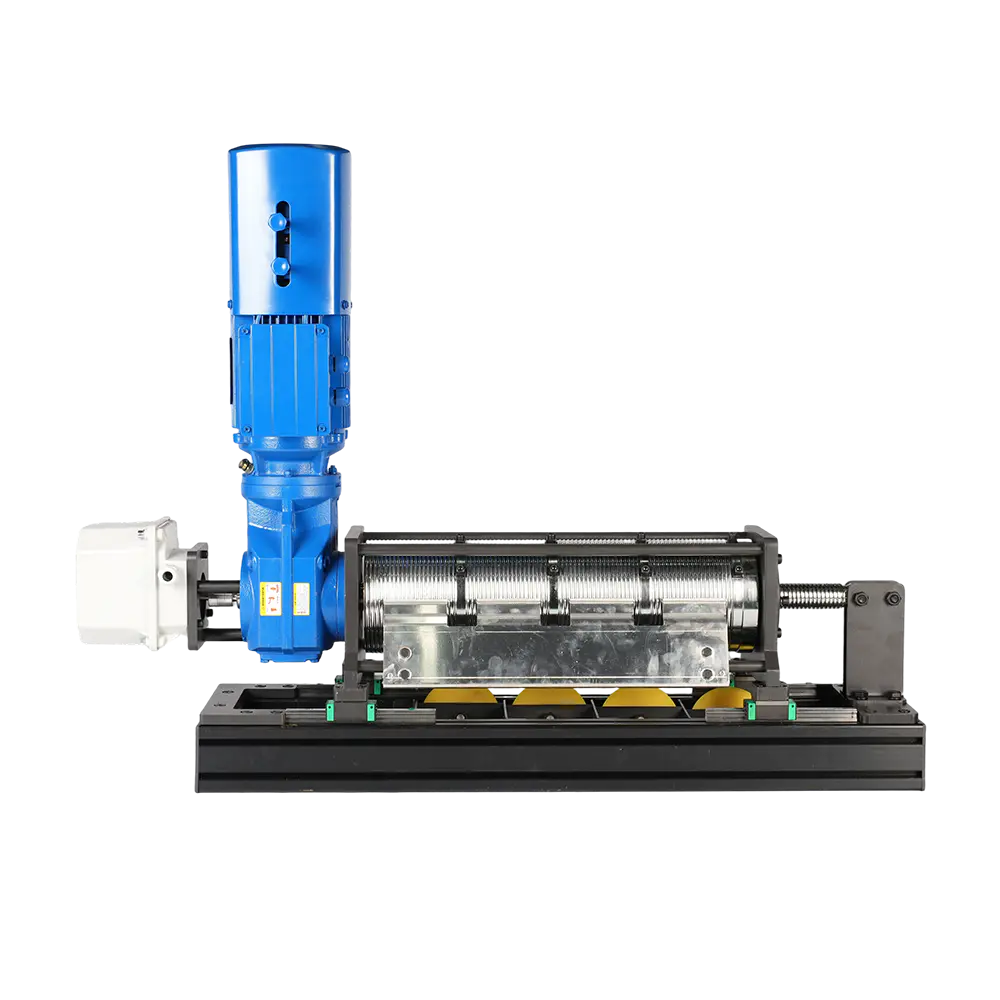
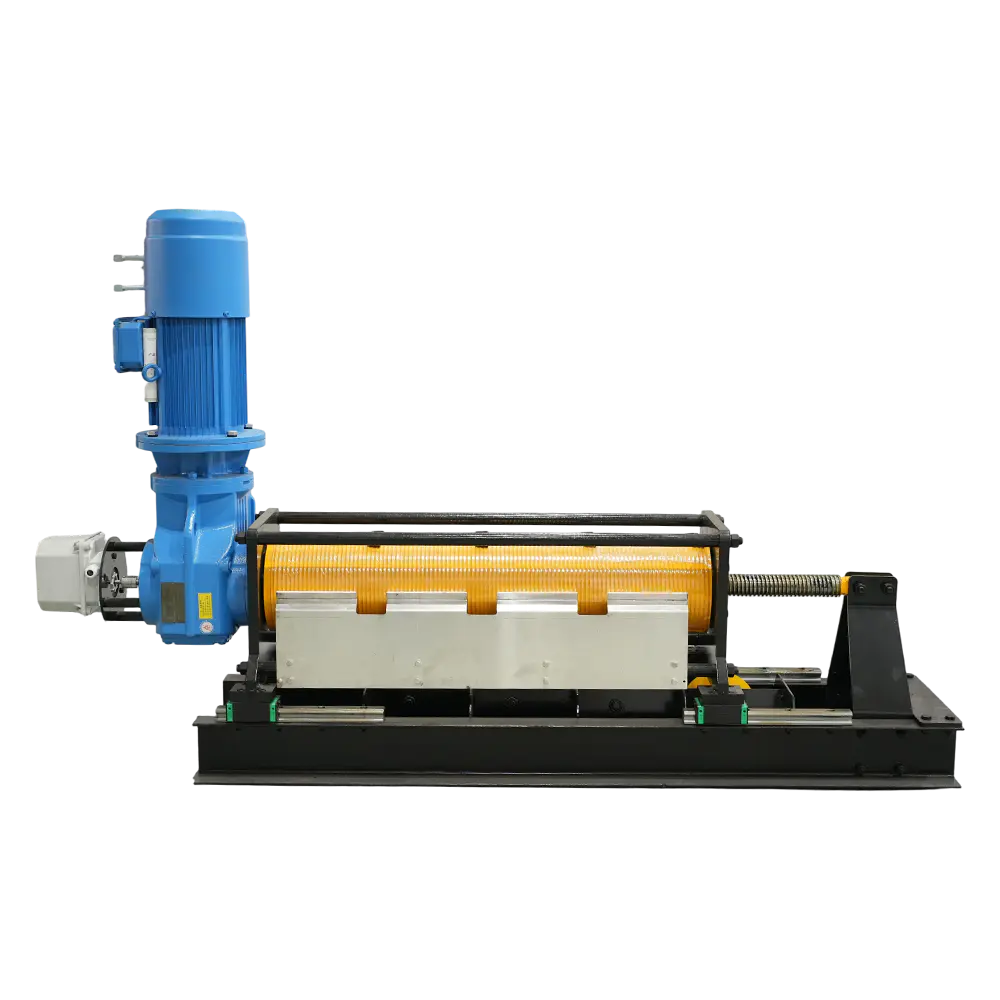
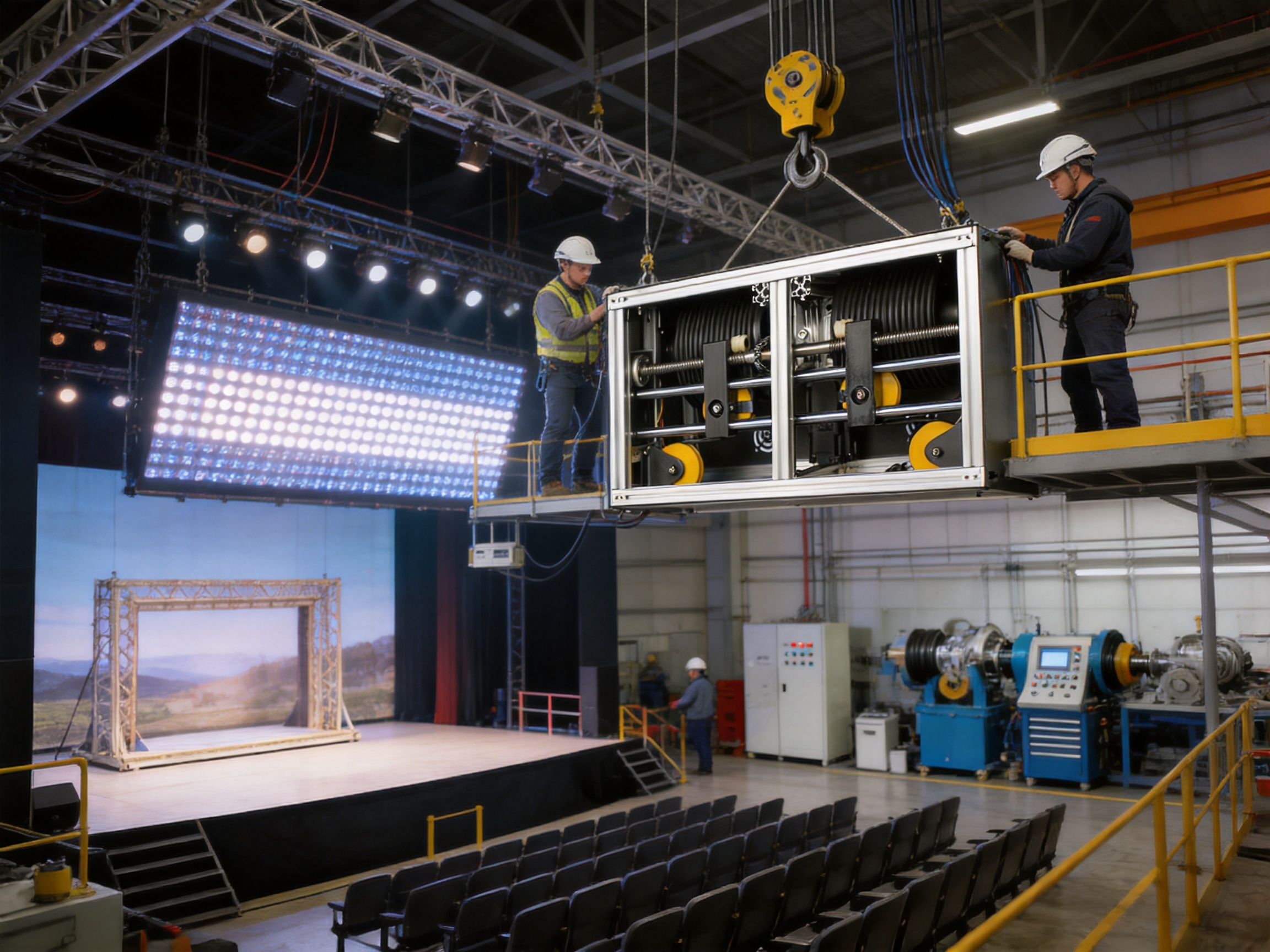
The Double Point Zero-Fleet Stage Winch is designed for this demanding environment. Driven by a high-performance servo motor and configured as a dual-point winch system, it uses DMX512 signal control to coordinate two lifting points. The result is a compact and intelligent lifting solution for equipment that must remain level and stable during movement. Its intended applications include theaters, bars, live shows, cultural venues, and other professional performance environments.
With a rated lifting load of 0.5 kilonewtons, approximately 50 kilograms, a lifting speed range of 0.005 to 0.5 meters per second, and a maximum travel distance of 15 meters, the system is suitable for controlled movement of lightweight and medium-duty production equipment. Its two lifting points provide greater control over wide or elongated loads than a conventional single-point hoist can offer.
The product is manufactured by RenteZhihe (JiangSu) Equipment Technology Co., Ltd., a high-tech enterprise focused on stage machinery, performance equipment, and intelligent control systems. The company combines research and development, mechanical manufacturing, electrical integration, software control, installation, commissioning, and maintenance into a complete service capability. This integrated approach allows the winch to be developed as part of a complete stage automation system rather than as an isolated lifting component.
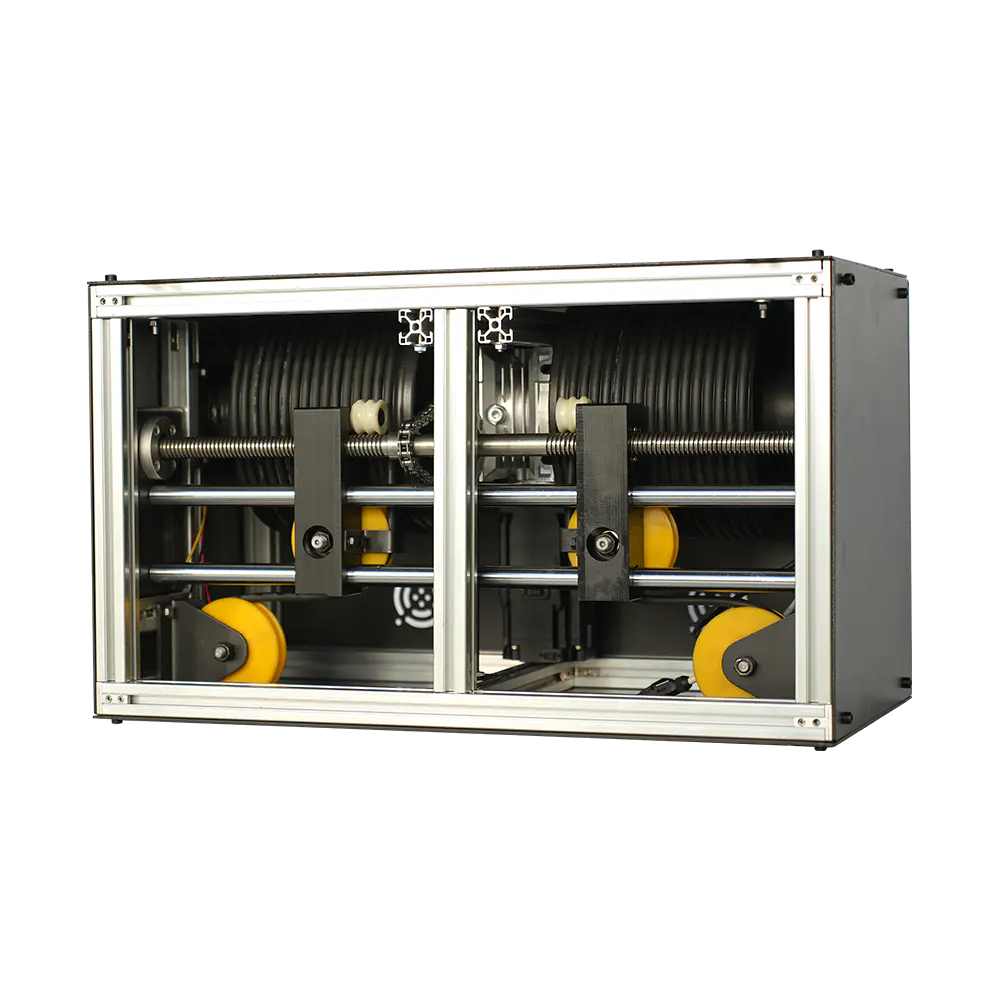
Double Point Zero-Fleet Stage Winch
A single-point winch is often sufficient for a compact fixture, a small decorative object, or a load whose center of gravity is precisely aligned with its suspension point. However, many modern stage elements are wide, rectangular, asymmetrical, or sensitive to tilting. Large LED screens, linear lighting arrays, banner structures, and scenic frames are examples of equipment that may require two suspension points.
With a single suspension point, a wide object can rotate or swing unless additional guide systems are installed. Even when the load is carefully balanced, changes in its center of gravity can affect its position. Equipment may be reconfigured between events, additional LED modules may be installed, or lighting fixtures may be moved along a truss. These changes can create uneven loading and make a single-point arrangement less suitable.
A dual-point system distributes the load across two winches. More importantly, it provides independent control over the two sides during installation, setup, and adjustment. Operators can level an LED screen, align a lighting structure, or correct a minor difference in suspension height before placing the equipment into synchronized movement mode.
The Double Point Zero-Fleet Stage Winch is engineered around this principle. Its two lifting points are controlled as part of one coordinated system, allowing the connected equipment to move as a stable assembly. The arrangement is particularly valuable when the visual appearance of the suspended object is important. A screen that tilts during movement can distract an audience, interrupt camera framing, or place additional stress on its mounting structure.
Dual-point lifting also supports more flexible load-in procedures. During installation, each lifting point can be checked and adjusted. Once the load is correctly positioned, the control system can coordinate both winches for synchronized operation. This combination of independent setup and coordinated movement is a practical advantage over simpler lifting arrangements that offer only a single point of control.
The winch uses a high-performance servo motor as its primary drive source. Servo technology is particularly appropriate for stage machinery because it supports accurate positioning, smooth acceleration, controlled deceleration, and repeatable operation. These characteristics are important when the suspended equipment must move at a predictable speed without sudden starts or stops.
The specified lifting speed range extends from 0.005 to 0.5 meters per second. The low end of the range supports fine positioning during focusing, installation, and alignment. The higher end allows the equipment to be moved efficiently during load-in, load-out, or programmed scene changes. The ability to operate across a broad speed range gives production personnel more control than a system with only one fixed lifting speed.
Slow movement is especially useful when positioning a lighting fixture near a truss, leveling an LED screen, or bringing a scenic element into a precise final location. At these moments, even a small change in height can affect the appearance of the production or the safe clearance between adjacent equipment. A servo-driven system can respond to small positioning commands with greater refinement.
Controlled acceleration and deceleration are also important for protecting the suspended load. Abrupt movement can cause swinging, cable stress, fixture vibration, and unnecessary mechanical shock. Smooth motion reduces these effects and helps maintain the alignment of the two suspension points. This is one reason servo systems are widely used in applications where precision and repeatability are more important than simple lifting force alone.
The maximum travel distance of 15 meters gives the winch practical flexibility for venues with substantial vertical clearance. It can be used for equipment that moves between a working position and a storage or maintenance position, provided that the complete installation is designed within the applicable load, travel, clearance, and safety requirements.
DMX512 is widely recognized as a control protocol for theatrical and entertainment lighting. In a modern automated stage system, however, its usefulness can extend beyond lighting fixtures. When incorporated into a dual-point winch system, DMX512 provides a familiar communication method for sending movement commands and coordinating equipment with the wider production environment.
The Double Point Zero-Fleet Stage Winch uses DMX512 signal control to support precise operation across multiple units. Each winch can be identified and addressed within the control network. This permits individual testing and adjustment during setup, while also allowing the two lifting points to operate together during a performance.
The distinction between individual and synchronized control is significant. During installation, an operator may need to raise one side slightly, lower the other side, or verify the response of each motor separately. During the show, the same equipment may need to move as one coordinated assembly. A flexible addressing and control arrangement supports both phases without requiring a completely separate control architecture.
DMX512 also allows winch commands to be incorporated into programmed cues. A lighting change, video sequence, scenic movement, and winch position can be coordinated as parts of the same production timeline. This is useful in live performances where visual elements must appear at precise moments and where manual control alone would introduce inconsistency.
For large LED screens and lighting structures, synchronized movement is more than a convenience. If one side starts moving earlier than the other or if the two points travel at noticeably different rates, the load can tilt. Even a small difference may be visible to the audience. The control system therefore has to treat the two winches as coordinated motion devices rather than unrelated motors.
The use of DMX512 does not eliminate the need for correct system design, commissioning, and operator training. Signal distribution, addressing, termination, cable routing, network configuration, and emergency procedures must all be considered. Nevertheless, using a familiar protocol can make integration easier for venues that already operate DMX-based lighting and show-control systems.
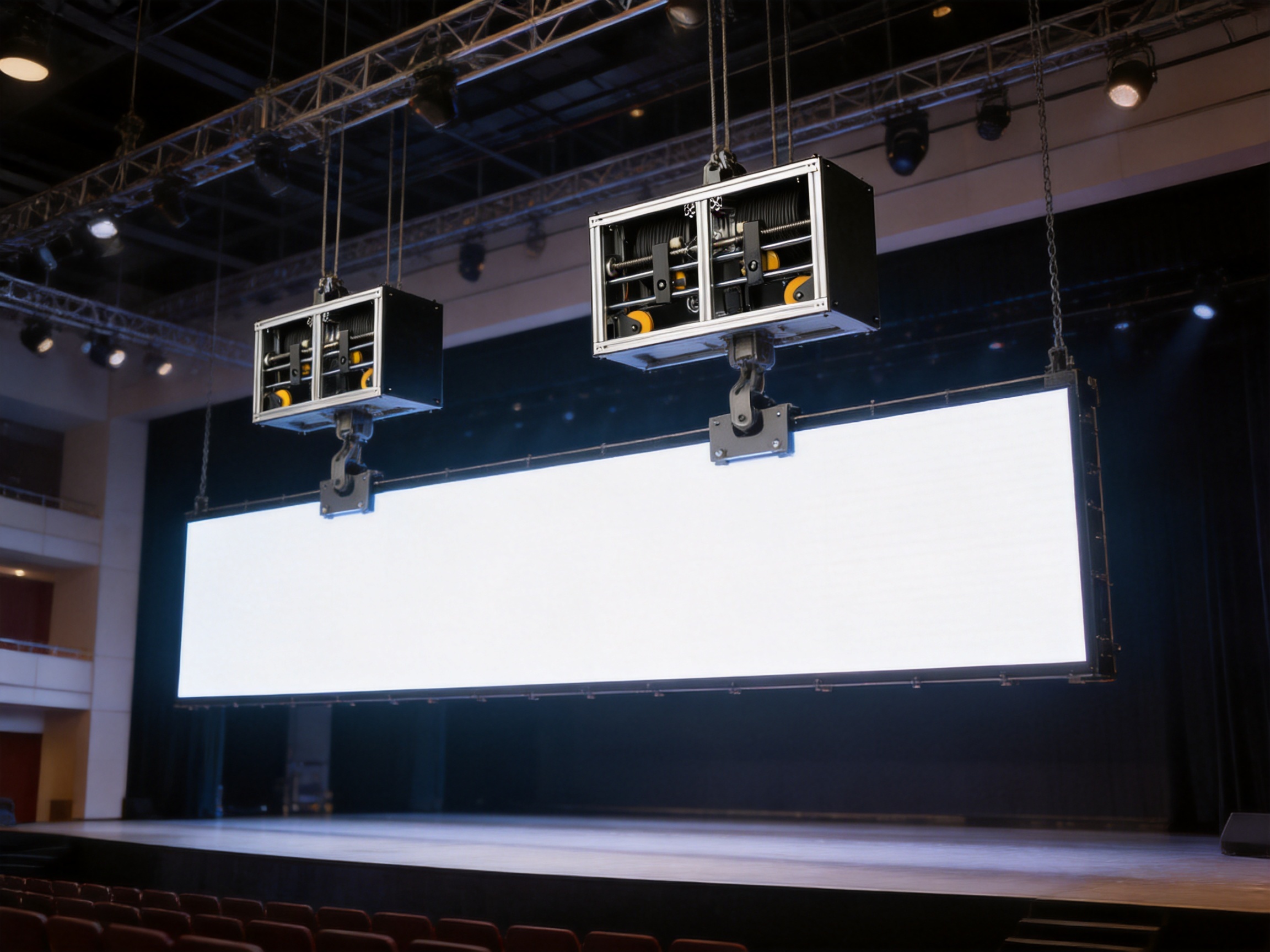
One of the product’s stated safety and performance features is precision control supported by a dual encoder arrangement. Encoders provide feedback about motor or drum position, allowing the control system to compare commanded movement with actual movement. In a two-point winch system, feedback is especially important because both sides must remain coordinated throughout the travel cycle.
Without appropriate feedback, a control system may send the same command to both motors while being unable to verify whether the two mechanisms have actually traveled the same distance. Differences can result from load distribution, mechanical resistance, cable winding conditions, or other operating factors. Encoder feedback allows the system to monitor the position of each lifting point and respond to deviations more accurately.
Dual encoder control supports several practical functions. It can help maintain synchronization, improve repeatability, assist with position calibration, and provide information for fault detection. It also gives technicians a better basis for diagnosing a problem because the control system can distinguish between a command issue, a motor response issue, and a difference in mechanical position.
For stage operators, the benefit is consistent positioning. A screen or fixture can be returned to a known height more reliably, which reduces the need for repeated manual correction. For maintenance teams, the benefit is greater visibility into the performance of the drive system. For production managers, the benefit is repeatable operation across many shows and changeovers.
Encoder feedback is not a substitute for inspection, proper rigging, or a complete safety system. It is one layer within a broader engineering approach. The winch still needs suitable structural support, correctly selected suspension cables, appropriate load calculations, and regular examination. When these elements are combined, feedback-based control can significantly improve the predictability of automated movement.
Two-point lifting introduces an important engineering issue: the load is not always divided perfectly equally between the two winches. A screen may contain heavier components on one side. A lighting array may have an uneven fixture layout. A scenic frame may shift its center of gravity as moving parts operate. Even a small difference in suspension geometry can affect how much force each lifting point carries.
The Double Point Zero-Fleet Stage Winch is intended to address this challenge through coordinated servo operation and feedback-based control. The goal is not merely to command equal motor speed. It is to maintain stable and controlled movement while recognizing that the actual mechanical demand on each side may differ.
Balanced load sharing helps reduce unnecessary stress on one winch. If one unit carries a disproportionately large part of the load for extended periods, its drive components, cable, bearings, and mechanical interfaces may experience accelerated wear. The other unit may operate below its practical contribution, producing an inefficient and less stable arrangement.
During commissioning, technicians should verify the load distribution, suspension geometry, travel limits, and alignment of the connected equipment. If the equipment is later modified, the balance should be checked again. Adding a video processor, changing a fixture position, or replacing a screen module can alter the center of gravity even when the overall weight remains within the rated capacity.
A system that supports independent point adjustment makes these changes easier to manage. Re-centering and leveling can be treated as controlled setup tasks rather than as repeated mechanical alterations. This is especially useful for venues with frequent productions and changing equipment packages.
| Application | Typical Movement Requirement | Primary Benefit of Two Points | Important Design Consideration |
|---|---|---|---|
| Large LED screen | Vertical movement with a level viewing surface | Improved leveling and reduced tilting | Continuous power, data, and careful cable management |
| Lighting array | Repeatable positioning during shows and setup | Stable support across a wide structure | Signal continuity and clearance from nearby equipment |
| Scenic frame | Programmed entrance, exit, or storage movement | Better control of long or asymmetrical elements | Center-of-gravity changes and travel limits |
| Venue display structure | Regular raising and lowering between events | Faster, more consistent changeovers | Inspection access and maintenance planning |
Suspending an LED screen or moving light is not simply a matter of attaching a load to a lifting cable. The equipment must often receive continuous electrical power and communication signals as it travels. This creates a cable-management challenge that must be considered at the same time as the mechanical lifting design.
LED screens may require power distribution, video data, monitoring connections, and control signals. Moving lights may need uninterrupted power and DMX communication. A scenic object may require only a lifting connection, but a production element containing integrated electronics can require several carefully routed cables.
The winch is specifically intended for equipment requiring integrated power and communication signals. This makes cable routing and protection central to the complete installation. Cables should be arranged so that they do not interfere with the lifting line, become trapped by moving parts, exceed their bend radius, or create unwanted tension on the suspended equipment.
Signal cables should also be routed to minimize interference and accidental disconnection. A mechanically stable lifting motion can still produce a production failure if the video signal drops or a lighting fixture loses control data. The mechanical and electrical portions of the installation therefore need to be commissioned together.
Production teams should define cable paths, service loops, attachment points, and inspection procedures before the winch is placed into regular operation. The correct arrangement will depend on the venue, the suspended equipment, the travel distance, the cable types, and the desired movement profile. The winch provides the controlled lifting platform, while the final cable-management solution must be engineered for the specific installation.
Stage equipment operates above performers, crew members, audiences, and valuable production assets. Safety therefore has to be considered at every stage, from component selection and manufacturing to installation, operation, inspection, and maintenance.
The product information identifies a high safety factor as one of the system’s principal safety functions. Over-designed components are intended to withstand loads beyond ordinary operating demands, providing an additional engineering margin when the equipment is correctly installed and used within its specified parameters.
A high safety factor should not be interpreted as permission to exceed the rated lifting load. The specified lifting capacity remains a fundamental operating limit. Safe use also depends on the supporting structure, the suspension accessories, the cable condition, the control system, the emergency procedures, and the environment in which the winch is installed.
Precision control is another important safety function. Accurate movement helps prevent unwanted tilting, sudden travel differences, and uncontrolled positioning. Dual encoder feedback provides information that supports stable travel in different operating conditions, while the servo system enables controlled acceleration and deceleration.
Long service life contributes to safety by reducing the likelihood of premature component deterioration when maintenance is properly performed. The product information emphasizes minimized maintenance cost and extra-long service life. These benefits are supported by over-designed components, feedback-based control, and a manufacturing approach that integrates mechanical and electrical functions.
Operators should establish regular inspection procedures covering lifting cables, attachment points, fasteners, motor performance, encoder feedback, signal connections, travel limits, emergency functions, and visible signs of wear. Records of inspections and corrective work can help identify gradual changes before they become operational problems.
RenteZhihe (JiangSu) Equipment Technology Co., Ltd. describes itself as a high-tech enterprise specializing in research and development, manufacturing, and intelligent control systems for stage equipment. This specialization is relevant because a dual-point stage winch is not only a mechanical product. It combines structural components, drive technology, control electronics, feedback devices, software logic, cable interfaces, and safety functions.
An integrated manufacturer can coordinate these disciplines during product development. Mechanical engineers can consider the requirements of the servo motor and encoder system. Electrical engineers can design the control and signal interfaces around the operating environment. Software and automation specialists can develop the synchronization logic. Production and commissioning personnel can then verify the completed assembly as one system.
This approach can provide an advantage over products assembled from unrelated components without a unified engineering responsibility. When the motor, control system, feedback devices, and mechanical transmission are selected and tested together, compatibility problems can be reduced. It also gives customers a clearer point of contact for technical support, customization, spare parts, and service.
The company’s manufacturing strengths include product research and development, stage machinery production, intelligent control integration, installation, commissioning, operation support, and maintenance. These capabilities allow the company to participate in a project from the early design stage through long-term use.
For a professional venue, this full-service capability can be more valuable than a low initial purchase price alone. The success of a stage winch depends on correct selection, structural coordination, signal integration, commissioning, and operator training. A manufacturer that understands the complete venue environment can provide more useful guidance than a supplier focused only on delivering a motorized lifting unit.
The company also serves theaters, cultural centers, stadiums, conference centers, and multifunctional performance spaces. These environments require different combinations of lifting height, payload, control integration, cable routing, and maintenance access. Experience across multiple venue types can help the engineering team identify practical requirements that may not be obvious in a basic product specification.
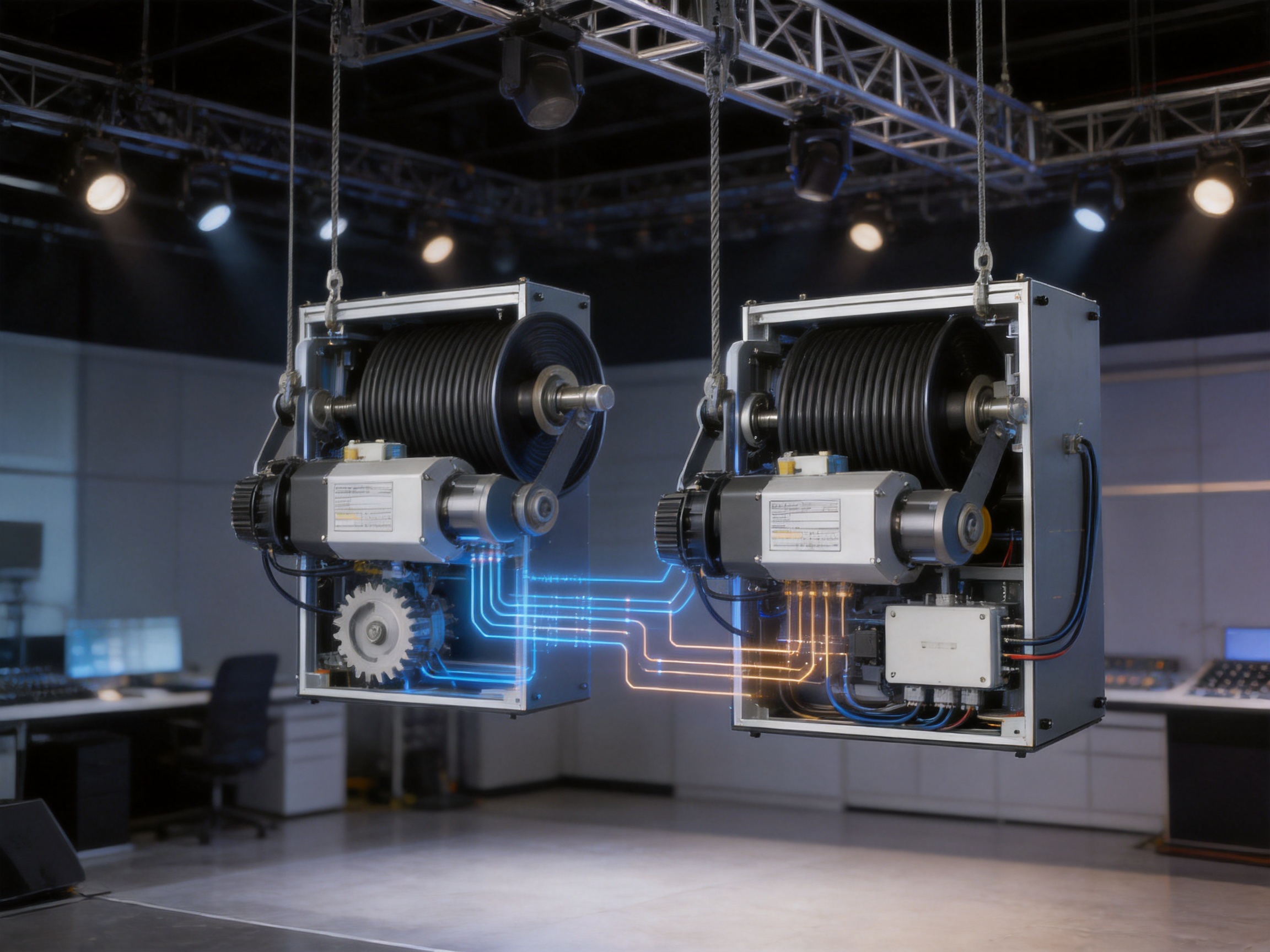
A reliable stage winch begins with controlled component selection. The servo motor, encoder, transmission elements, lifting cable, fasteners, control electronics, and protective components must be selected according to the intended load and operating cycle. Components should be compatible not only in physical dimensions but also in their electrical, thermal, and control characteristics.
Mechanical assembly requires careful attention to alignment. In a dual-point system, small differences in the relationship between the two winches can become visible when a long or wide load is moved. Proper alignment of drums, cables, mounting interfaces, and guide components helps the two lifting points operate as a coordinated pair.
Electrical assembly must verify signal connections, motor wiring, encoder feedback, grounding, protection, and control interfaces. DMX512 communication should be checked for correct addressing and stable transmission. The control system should be tested in both individual and synchronized modes so that technicians can confirm the intended operating behavior.
Factory testing should include no-load and representative-load checks where applicable. The system can be evaluated for start and stop behavior, speed response, position repeatability, encoder feedback, synchronization, travel range, and abnormal operating conditions. Testing should also confirm that maintenance access is practical and that service personnel can identify major components without unnecessary disassembly.
Final commissioning at the venue is equally important. The actual installation may include different structural conditions, cable paths, control equipment, and surrounding obstructions than the factory test environment. The completed system should be verified under site conditions, including movement through the full intended travel path and operation with the actual suspended equipment.
This manufacturing and commissioning process supports the product’s main competitive advantages: controlled movement, integrated communication, repeatable positioning, flexible dual-point setup, and long-term serviceability. These advantages are most effective when supported by disciplined engineering rather than treated as isolated features.
The most obvious advantage of the Double Point Zero-Fleet Stage Winch is its two-point configuration. Conventional single-point systems can be simple and economical for small centered loads, but they may require additional stabilization when used with wide screens, long trusses, or asymmetrical structures. The dual-point design directly addresses the need for level and coordinated movement.
A second advantage is its servo-driven control. Basic hoists may provide lifting and lowering functions without offering the same degree of speed adjustment, position feedback, or programmed movement. Servo technology supports smoother operation and more precise positioning, which is important for visually sensitive stage applications.
A third advantage is DMX512 compatibility. Venues that already use DMX512 for lighting control may be able to integrate winch movement into an established control environment. This can simplify show programming and allow lighting, video, and automated movement to be coordinated within the production workflow.
A fourth advantage is the use of dual encoder feedback. Position monitoring improves synchronization between the two lifting points and provides greater control visibility. It also helps support repeatable movement over repeated show cycles.
A fifth advantage is the emphasis on integrated power and communication support for moving equipment. The system is designed around the practical needs of lighting fixtures and LED screens, not only around the lifting of passive scenic objects. This makes it more relevant to modern productions in which suspended equipment remains electronically active while moving.
Finally, the manufacturer’s full engineering and service capability can provide an advantage in complex projects. Customers may receive support covering design, production, installation, commissioning, operation, and maintenance rather than having to coordinate multiple unrelated suppliers.
In theaters, the winch can be used for lighting fixtures, LED displays, scenic frames, and other automated elements that need to move between performance and maintenance positions. The dual-point arrangement is useful when the suspended object is wide or when precise leveling is essential to the visual design.
In bars and clubs, equipment may need to move frequently to accommodate different event formats. A lighting structure or display can be raised for a show and moved to a different position for cleaning, maintenance, or a new layout. The winch’s controlled travel and DMX512 integration can support repeatable changeovers.
In live shows, production schedules are often tight. Equipment must be loaded, adjusted, tested, and operated with minimal delay. Independent setup of the two lifting points can help technicians level the equipment before a performance. Synchronized operation can then support programmed movements during the event.
Cultural centers and multifunctional venues may host concerts, conferences, ceremonies, exhibitions, and community events. Their equipment often needs to serve different layouts rather than one permanent stage configuration. A flexible dual-point system can contribute to this adaptability when the installation is properly planned and the suspended payload remains within the specified capacity.
Conference centers may use automated display structures, projection-related equipment, or decorative elements that need to be stored above the audience area when not required. In such cases, precise movement and reliable positioning can help maintain a clean venue appearance while preserving operational flexibility.
Before installation, the project team should define the exact payload, dimensions, center of gravity, travel distance, desired speed, cable requirements, mounting structure, control architecture, and maintenance access. The 0.5 kilonewton lifting load and 15-meter maximum travel should be treated as core design boundaries rather than approximate recommendations.
The support structure must be capable of carrying the operating and dynamic loads associated with the winch and suspended equipment. Mounting points should be checked for alignment and accessibility. The two winches should be installed so that their travel paths are parallel and their relationship to the suspended frame is appropriate for the intended movement.
Control addressing should be planned before commissioning. Each unit should be identifiable, and technicians should be able to test the lifting points independently. The synchronized operating mode should be configured only after the individual responses, limits, feedback signals, and mechanical connections have been checked.
Cable management should be treated as part of the installation design. Power and data cables require adequate service length without excessive slack. They should be protected from abrasion, crushing, sharp edges, heat, and interference with moving components. The cable arrangement should be observed through the entire travel path rather than checked only at the upper and lower positions.
Operators should use established movement procedures. The area below and around the suspended load should be controlled during operation. The load should not be moved when unexpected obstructions, personnel, or unverified modifications are present. Any unusual noise, vibration, movement difference, signal loss, or position error should be investigated before normal operation resumes.
Regular maintenance should follow a documented schedule. Inspection intervals may depend on operating frequency, environmental conditions, load characteristics, and venue procedures. Cleaning, lubrication where applicable, cable inspection, fastening checks, feedback verification, and functional tests should be recorded by qualified personnel.
A double-point stage winch is a lifting system that uses two coordinated winch units to raise, lower, and position one suspended object. The two points can be adjusted independently during setup and operated in synchronization during programmed movement.
The product is intended for equipment such as lighting fixtures, large LED screens, lighting arrays, and other stage elements requiring integrated power and communication signals. The total lifting load is specified as 0.5 kilonewtons, approximately 50 kilograms, and the actual payload must remain within the complete installation’s approved limits.
LED screens are usually wide and visually sensitive to tilting. Two lifting points allow technicians to level the screen during setup and help maintain a stable orientation during movement. The arrangement also supports more controlled handling when the screen’s weight is not perfectly centered.
DMX512 sends control information through the stage automation network. The winch units can be addressed for individual testing and adjustment, then configured for synchronized operation. This allows lifting movements to be incorporated into programmed production cues alongside lighting and other show-control functions.
The servo motor provides controlled and repeatable movement across the specified speed range. It supports slow positioning for alignment as well as faster travel for load-in and load-out. Servo operation also contributes to smoother acceleration and deceleration.
Dual encoder feedback monitors the position or movement response of the two winch units. It helps the control system maintain synchronization, improve positioning accuracy, identify differences between the two lifting points, and support troubleshooting during commissioning and maintenance.
The specified maximum travel distance is 15 meters. The actual usable travel must also consider the venue structure, clearance, cable routing, equipment dimensions, operating limits, and the requirements of the completed installation.
The specified lifting speed range is 0.005 to 0.5 meters per second. The lower speed supports fine positioning, while the higher speed helps move equipment efficiently during setup and changeover operations.
The product is engineered for suspended equipment requiring integrated power and communication signals. However, the specific cable arrangement must be designed for the payload, travel path, bend radius, protection requirements, and venue conditions. Cable management should be commissioned together with the winch.
No. The system is intended for loads within its specified capacity and application range. Payload weight, center of gravity, dimensions, supporting structure, cable arrangement, and movement requirements must all be reviewed before use. Heavy scenery or large structures may require a different lifting solution.
Its principal differentiators are dual-point operation, servo-driven movement, DMX512 control, dual encoder feedback, adjustable synchronization, and suitability for equipment that remains connected to power and communication systems while moving.
Commissioning should verify mounting alignment, payload distribution, cable routing, motor response, encoder feedback, DMX512 addressing, individual and synchronized travel, limits, acceleration and deceleration, clearance, emergency procedures, and maintenance access.
RenteZhihe (JiangSu) Equipment Technology Co., Ltd. provides capabilities covering design, production, installation, commissioning, operation, and maintenance. This supports customers that need more than a standalone product shipment and require an integrated stage automation solution.
The Double Point Zero-Fleet Stage Winch is designed for a stage environment in which precision, stability, and system integration are essential. Its dual-point configuration provides a practical solution for wide and visually sensitive loads. Its servo motor supports smooth and repeatable movement, while DMX512 control allows winch operation to become part of the wider production system.
Dual encoder feedback strengthens synchronization and position control. The ability to adjust the two lifting points independently during setup provides useful flexibility for leveling screens, lighting arrays, and scenic structures. Integrated consideration of power and communication cables makes the product relevant to modern suspended equipment rather than only passive lifting loads.
The product’s advantages are reinforced by the manufacturer’s integrated capabilities in research and development, mechanical production, intelligent control, installation, commissioning, and maintenance. This combination is important because reliable stage automation depends on the complete relationship between the winch, the control system, the supporting structure, the payload, and the operating team.
For theaters, bars, live shows, cultural centers, conference venues, and multifunctional performance spaces, the winch offers a compact and adaptable method for controlled two-point lifting. When selected within its rated specifications and installed, commissioned, and maintained by qualified professionals, it can help venues achieve more consistent equipment movement, faster changeovers, and more dependable show operation.
1. RenteZhihe (JiangSu) Equipment Technology Co., Ltd. Product technical specifications for the Double Point Zero-Fleet Stage Winch.
2. RenteZhihe (JiangSu) Equipment Technology Co., Ltd. Company information regarding stage machinery, performance equipment, intelligent control systems, installation, commissioning, and maintenance services.
3. Entertainment Technology Industry Association. Recommended practices for DMX512-based control systems in entertainment environments.
4. International Electrotechnical Commission. General principles for electrical safety, control equipment, and industrial automation systems.
5. Professional stage machinery engineering practices concerning suspended loads, dual-point lifting, encoder feedback, cable management, inspection, and commissioning.
We specialize in delivering advanced stage machinery, rigging systems and intelligent control solutions for performance spaces worldwide.

No. 111 Runfeng Road, Hailing District, Taizhou City, Jiangsu Province, China

rtstage@163.com

+86-139 1771 1698

+86-139 1771 1698
rtstage@163.com
 中文简体
 English
 русский
 Français
 Español
 عربى